|
|
|
WASTE MANAGEMENT
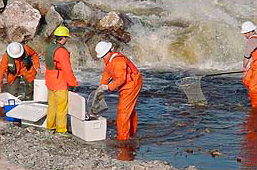 We are focused on recovering, reducing, reusing and recycling waste materials whenever feasible.
PCBs
Polychlorinated Biphenyls (PCB) is the most important waste management issue in the electric utility industry. This substance was commonly used in electrical equipment prior to the late 1970s, when PCB production was banned. The effect of this ban on Hydro and many other utilities was two-fold. The amount of PCB in service declined as new PCB-free equipment was installed and inventories of PCB-contaminated wastes increased as older equipment was retired.
During the 1980s and 1990s, Hydro implemented significant initiatives to reduce risks associated with in-service equipment containing PCB. This included removal from service or decontamination of all transformers which had been manufactured with high concentrations of PCB. As well, all transformers filled with large volumes of PCB-contaminated oil were decontaminated.
Some low-risk, older equipment, such as florescent light ballasts which contain small amounts of PCB, are managed to prevent any releases into the environment, and will remain in service for their life. A portion of older distribution equipment, currently in service, contains oil that is contaminated with low-level PCB. Hydro’s policy is to test this equipment for PCB contamination during emergency and planned maintenance, and collect all PCB contaminants for proper disposal.
In 2006, two tonnes of low-level PCB material was placed in storage at Hydro’s Bishop’s Falls PCB waste storage facility. No low-level PCB material was removed from storage during 2006. As of December 31, 2006, there was two tonnes of low-level PCB material and no high-level PCB material in storage. This is depicted in Table 1.
|
PCB Material In Storage (Bishop’s Falls PCB Waste Disposal Facility) |
2005
(Tonnes) |
2006
(Tonnes) |
|
|
Total inventory of high-level PCB material in storage |
0 |
0 |
|
|
Total inventory of low-level PCB material in storage |
11 |
2 |
|
|
Total amount of high-level PCB material sent for destruction |
0 |
0 |
|
|
Total amount of low-level PCB material sent for destruction |
13 |
0 |
|
|
Total amount of high-level PCB material taken out of service |
0 |
0 |
|
|
Total amount of low-level PCB material taken out of service |
0 |
2 |
|
|
PCB Material In Service (TRO Operations) |
2005
(Tonnes) |
2006
(Tonnes) |
|
|
Total estimated inventory of high-level PCB material in service |
<1 |
<1 |
|
|
Total estimated inventory of low-level PCB material in service |
0 |
unknown |
|
Table 1: PCB material in storage and in service in 2005 and 2006.
It is recognized that some older equipment such as capacitors and fluorescent light ballasts, which may contain high levels of PCB, remains in service. It is estimated that there is less than one tonne of PCB contained in this equipment.
A portion of the older distribution transformers in service throughout the system contain oil that is contaminated with PCB to a level greater than 50 parts per million (ppm). Hydro has therefore initiated a program to reduce the amount of PCB-contaminated equipment in service. The multi-year program involves the identification, testing, and removal from service or refurbishment of all electrical equipment with a PCB level greater than 50 ppm.
Table 2 provides an inventory of PCB material in storage and in service at Churchill Falls facilities as of December 31, 2006. At present, the total amount of low and high-level PCB material in storage in the Churchill Falls PCB waste storage facility is less than one tonne. There was less than one tonne of high and low PCB material sent for destruction in 2006. PCB material known to be in service are ballasts and capacitors; however, there is no inventory completed of this electrical equipment to date.
Back to Top
|
PCB Material In Storage (CF(L)Co) |
2005
(Tonnes) |
2006
(Tonnes) |
|
|
Total inventory of high-level PCB material in storage |
<1 |
<1 |
|
|
Total inventory of low-level PCB material in storage |
<1 |
0 |
|
|
Total amount of high-level PCB material sent for destruction |
0 |
<1 |
|
|
Total amount of low-level PCB material sent for destruction |
0 |
<1 |
|
|
Total amount of high-level PCB material taken out of service |
<1 |
<1 |
|
|
Total amount of low-level PCB material taken out of service |
<1 |
0 |
|
|
PCB Material In Service (CF(L)Co) |
2005
(Tonnes) |
2006
(Tonnes) |
|
|
Total estimated inventory of high-level PCB material in service |
0 |
unknown |
|
|
Total estimated inventory of low-level PCB material in service |
0 |
unknown |
|
Table 2: PCB material in storage and in service in 2005 and 2006.
Reuse and Recycling Initiatives
Lubricating Oil
Hydro currently has a waste oil management system for handling and disposing of various types of used oil. In the past, however, records on the amount and type of oil being reused and recycled were not always kept. Hydro has made significant progress over the last couple of years in this area. Hydro now records on an annual basis the amount of used base oil generated and new oil purchased at the company’s Diesel Generating Stations. In 2006, approximately 54,443 litres of used base oil was collected from these diesel stations for either recycling or reuse.
At Hydro’s central maintenance facility in Bishop's Falls, approximately 67,000 litres of insulating oil was reused. Approximately 46,000 litres of this insulating oil was reused following processing or cleaning by internal forces, while 21,000 litres was reused following processing or cleaning by a third-party contractor.
At CF(L)Co, approximately 31,570 litres of used lubricating oil, 3,280 litres of low-flash point liquids, 820 litres of paint, and 410 litres of grease were collected and disposed of by a third-party contractor for reuse or recycling in 2006. Approximately 187,000 litres of insulating oil was collected and disposed of by a third-party contractor for reuse or recycling.
Wood Pole Line Management Program
Hydro, as part of its transmission line network, manages approximately 26,000 poles of varying age. Wooden poles have an economic lifespan of about 40 years and an in-service lifespan of 50 years. With proper management, maintenance and refurbishment the life can be extended by at least 10 years or more. In Hydro's transmission system, just over one third of all poles are at or over 30 years and are reaching the end of their useful life. Core samples taken from some poles in 1998 indicated that the preservative retention level was not adequate. As a result, Hydro initiated a wood pole line management program in 2003 and it is expected to continue as a long-term asset management and life extension program. In 2006, Hydro treated 2,980 poles with boron rods. In 2006, 1,224 treated wood poles were removed from service; 24 were removed to landfills, while 1,200 were recycled.
Back to Top
Disposal of Fuel Ash at Holyrood Thermal Generating Station
Hydro has no flue gas desulphurization system nor does it have a fluidized bed combustion process. In earlier years, ash from the fuel oil used at the Holyrood Thermal Generating Station was sold for the vanadium content, but in recent years the combination of a lower vanadium content fuel specification and a drop in the market price of vanadium have eliminated this option. During 2006, all fuel ash was disposed of in an on-site, controlled solid waste landfill. The amount of total ash produced and disposed of at the landfill in 2006 was 201 tonnes.
Scrap Metal Recycling and Reuse
During 2006, Hydro decommissioned 398 distribution transformers, all of which were sold to a transformer manufacturer for reuse. Of the 398 transformers, 77 transformers with stainless steel tanks were re-furbished and shipped back to Hydro for reuse. In addition, approximately 70 tonnes of scrap aluminum/steel tower components and miscellaneous scrap were auctioned and recycled. Approximately 53 tonnes came from the Holyrood Thermal Generating Station facility, while the remainder came from Hydro's central maintenance facility in Bishop's Falls.
Waste Audit and Landfill Diversion Options
In 2006, to facilitate planning of activities aimed at diverting solid waste from the landfill, CF(L)Co engaged a consultant to identify and quantify solid waste streams and to develop options for waste diversion. Phase 1 of the study involved the identification and analysis of solid wastes generated at CF(L)Co by residential, commercial and industrial operations. Phase 2 involves the identification and implementation of waste diversion options, such as reduction alternatives, recycling and composting. Phase 2 will be completed during the first half of 2007. It is expected that the viable waste diversion alternatives will be implemented over the next few years.
Construction Debris Removal Plan Revised
In 2006, CF(L)Co management was requested by the Board of Directors to provide a status report on the extent of the remaining construction debris to be cleaned up and removed from abandoned construction camps that were used as part of the original construction of the Churchill Falls Project. The status report identified that the extent of the remaining cleanup was more significant than previously understood. It was concluded that given the geographic locations of some of the remaining sites and the relatively short season to perform removal, the construction debris removal project would still require significant time and financial resources for completion.
Based on this, CF(L)Co proposed and received approval for additional funding for the next five years for site cleanups. Based upon progress and possible new discoveries during the five year program, a contingency was also allocated for a sixth year. For each of the next five years, CF(L)Co proposes to cleanup five large sites with the aid of contractors and five smaller sites with CF(L)Co personnel.
|
|
|