|
|
ENVIRONMENTAL POLICY AND GUIDING PRINCIPLES
We will help sustain a diverse and healthy environment for all Newfoundlanders and Labradorians and will maintain a high standard of environmental responsibility and performance. Newfoundland and Labrador Hydro (Hydro) will help sustain a diverse and healthy environment for present and future Newfoundlanders and Labradorians by maintaining a high standard of environmental responsibility and performance through the implementation of a comprehensive environmental management system. The following guiding principles set out Hydro’s environmental responsibility: Prevention of Pollution
|
||||||||||||||||||||||||||||||||||||||||||||||||||||||||||||||||||||||||||||||||||||||||||||||||||||||||||||||||||||||||||||||||||||||||||||||||||||||||||||||||
|
ABOUT HYDRO We are proud of our record of service and will strive for continual improvement in all areas of our operations as we meet the energy needs of Newfoundland and Labrador. Newfoundland and Labrador Hydro (Hydro) is a Crown corporation owned by the Province of Newfoundland and Labrador. Hydro is the parent company of Churchill Falls (Labrador) Corporation, Lower Churchill Development Corporation, Gull Island Power Company and Twin Falls Power Corporation. Headquartered in St. John’s, Hydro supplies over 80 per cent of the province’s electrical energy. Hydro is the fourth largest power utility in Canada, with 7,288 megawatts (MW) of installed generating capacity, and is the province’s main energy provider with electrical sales of 39,715 gigawatt hours (GWh) in 2006, 8,397 GWh for domestic use and 31,318 GWh for export. The company has over 1,200 employees in four lines of business: Regulated Operations; Churchill Falls Operations; Lower Churchill Project; and Business Development. Regulated Operations: This division’s mandate is to deliver safe, reliable, least-cost power to industrial, utility and over 35,000 direct customers in rural Newfoundland and Labrador. The division has over 860 employees, focused on safety, environment, conservation and efficient operations. Division assets include: nine hydro-electric generating stations; one oil-fired plant; four gas turbines; three interconnected diesel generating stations; and, 21 isolated diesel generating and distribution systems. Hydro also maintains 54 high-voltage terminal stations, 25 lower-voltage interconnected distribution substations, 3,742 km of interconnected high-voltage transmission lines and 3,334 km of distribution lines. Churchill Falls Operations: Approximately 220 employees keep the Churchill Falls Generating Station operating efficiently year round. Lower Churchill Project: The 2,824 MW Lower Churchill Project will deliver a long-term supply of reliable, clean electricity to meet the growing energy demands of all customers in the province, and potentially Ontario, Québec, the Maritime Provinces and the northeast United States. The project will generate electricity to power approximately 1.5 million homes and displace 16 megatonnes of carbon dioxide emissions annually from comparable coal thermal production. Business Development: Hydro is pursuing business opportunities in oil and gas; wind generation; alternative energy sources; and, research and development. Hydro is exploring opportunities in the oil and gas sector with an approach to maximizing benefits from this resource to help build a stronger economy and support its pursuit of renewable resource developments. On the island and in isolated diesel communities, energy from wind generation has the potential to address electricity demands in the province while reducing the reliance on thermal generation. In Labrador, it also has the potential to be developed for export to other markets. |
||||||||||||||||||||||||||||||||||||||||||||||||||||||||||||||||||||||||||||||||||||||||||||||||||||||||||||||||||||||||||||||||||||||||||||||||||||||||||||||||
|
MESSAGE FROM THE PRESIDENT AND CEO 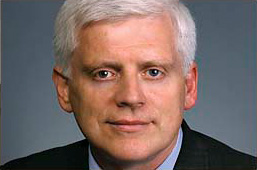 To be an environmental leader.
I’m proud to release our 7th Annual Environmental Performance Report. This report highlights our accomplishments, our ongoing commitment to the environment, our focus on our environmental efforts and opportunities for future improvement. Through our Environmental Performance Reports, Hydro demonstrates not only the commitment within the Hydro Group to environmentally-sound practices and good stewardship of our natural resources, but also our commitment to ensure that we report on our environmental activities to stakeholders. Throughout 2006, we spent considerable time on our corporate planning process which focused the company around eight long-term corporate goals. While many of those goals focus on specific aspects of our business, one goal intersects and impacts our entire organization: To Be an Environmental Leader. A key measure of Hydro’s impact on the environment is our sulphur dioxide emissions from thermal generation. In 2006, Hydro took a number of steps to reduce sulphur emissions from our operations, including: switching to a lower-sulphur fuel at the Holyrood Thermal Generating Station; pursuing wind generation opportunities to help reduce the amount of fuel burned at the Holyrood plant; investigating environmentally-friendly energy solutions for our isolated diesel systems; aggressively promoting energy efficiency and conservation; and advancing the Lower Churchill Project. In 2006, we outperformed our target for reducing sulphur emissions at the Holyrood Thermal Generating Station, achieving almost a 60 per cent reduction in emissions compared to 2005. This achievement was possible for a number of reasons: increased hydro generation due to increased water in our reservoirs; lower energy demand; and the change to a cleaner, lower-sulphur fuel. The move to a 1 per cent sulphur fuel from 2 per cent at the Holyrood plant will reduce our sulphur emission rate by 50 per cent and particulate emission rate by up to 60 per cent. During the year, Hydro took significant steps toward the integration of wind generation into our electricity systems and awarded two contracts for over 50 megawatts of wind power on the island. Together, these projects, when on stream in 2009, will displace 300,000 barrels of oil annually at the Holyrood plant, reduce sulphur dioxide emissions by over 900 tonnes, carbon dioxide by over 140,000 tonnes, and generate green energy for thousands of homes. Hydro also started monitoring the wind potential in Labrador. In addition, the company secured approval and funding for a research and development project to integrate hydrogen with wind power and diesel generation. The Lower Churchill resource is one of the highest value, undeveloped hydro resources in Canada. Hydro is moving ahead with the necessary activities to achieve sanction of the Lower Churchill Project in 2009 and deliver first power in 2015. The Project has the potential to generate a long-term supply of reliable, clean, renewable energy to power approximately 1.5 million homes and displace 16 megatonnes of carbon dioxide emissions annually from comparable coal thermal production. We strengthened our focus on energy conservation in 2006 and are taking a leadership role in providing conservation programming in the province. Our new energy conservation manager is working with partners including Newfoundland Power, the provincial government and other stakeholders to develop a coordinated approach for conservation education and awareness initiatives. Through HYDROWISE, our energy conservation program, we launched a new energy efficiency website and provided incentives and financing for home insulation upgrades. I would like to commend our dedicated team of employees for their ongoing commitment to their work, the environment and our organization. Protection of our environment goes hand-in-hand with our mandate to provide our customers with safe, reliable, least-cost electricity. I encourage you to read this year’s report and as always, I welcome your feedback. Ed Martin President and CEO |
||||||||||||||||||||||||||||||||||||||||||||||||||||||||||||||||||||||||||||||||||||||||||||||||||||||||||||||||||||||||||||||||||||||||||||||||||||||||||||||||
|
HIGHLIGHTS 2006 We will integrate environmental considerations into decision-making processes at all levels. As the primary generator of electricity in the province and a committed member of the community, Hydro has a commitment and responsibility to protect the environment. Hydro’s commitment to environmental leadership can be seen across the business through its ISO 14001 certified Environmental Management System. Hydro’s Environmental Management System and ISO 14001 certification are key components of this commitment and they will continue to be the cornerstone of the company’s environmental work.
|
||||||||||||||||||||||||||||||||||||||||||||||||||||||||||||||||||||||||||||||||||||||||||||||||||||||||||||||||||||||||||||||||||||||||||||||||||||||||||||||||
|
OUR PEOPLE Employees across Hydro reflect the commitment of the company to its responsibility to excellence in environmental management. Management Representatives Committee Hydro's Environmental Management System allows for the management of its environmental affairs and is applied to all activities, products and services that can have an impact on the environment. Overseeing the operational management of the Environmental Management System is the Management Representatives Committee (MR Committee) with representatives from each of the Management Areas (MA) within the Environmental Management System. The MR Committee meets on a regular basis and provides the following:
In 2006, the MR Committee included: Frank Ricketts, Corporate MA; Rob Bartlett, Hydro Operations MA; Cindy Hayes, CF(L)Co MA; Rod Healey, Services MA; Wayne Rice, Holyrood MA; and Paul Smith, Transmission and Rural Operations MA. Environmental Services Department While everyone at Hydro plays an important role in ensuring the organization meets its environmental commitments, the Environmental Services Department has the lead responsibility for areas of: environmental reporting; environmental training and awareness; environmental impact and site assessment; environmental auditing; identifying appropriate environmental standards; and tracking environmental issues. As well, the Department provides advice and service to all divisions in Hydro to assist them with their legislative compliance responsibilities. |
||||||||||||||||||||||||||||||||||||||||||||||||||||||||||||||||||||||||||||||||||||||||||||||||||||||||||||||||||||||||||||||||||||||||||||||||||||||||||||||||
|
ENVIRONMENTAL MANAGEMENT SYSTEMS Our commitment to environmental leadership can be seen across our business through our ISO 14001 certified Environmental Management System. In 2006, with a renewed mandate and refocused organization, Hydro set strategic goals to guide its business into the future. One of those goals highlights the organization’s ongoing and continued commitment to environmental responsibility. Goal: To Be an Environmental Leader As a company and a member of the community, Hydro has a responsibility to protect the environment. The company’s commitment to environmental leadership can be seen across the business through its ISO 14001 certified Environmental Management System. Hydro’s Environmental Management System and ISO 14001 certification are key components of this commitment and they will continue to be the cornerstone of the company’s environmental work. Hydro’s structured and consistent management approach to dealing with environmental issues facing Hydro has proven to be successful, and the company has committed to continue to build on the success achieved in 2006. Hydro’s Environmental Management Systems provide the company with a solid framework for environmental management and continual improvement. Hydro is committed to managing its operations to reduce its environmental impact, while balancing its mandate to provide customers with safe, reliable, least-cost power. All Hydro divisions have been ISO 14001 certified since 2004, and this gives added assurance to all stakeholders of continued environmental excellence. The six designated management areas (Figure 1) within Hydro manage their environmental aspects through Environmental Management Systems consistent with ISO 14001. Each Environmental Management System is certified and registered by a third party, Quality Management Institute. In 2006, Hydro continued to show improvements on environmental Key Performance Indicators, electronic Environmental Management System documentation, Environmental Management System surveillance audits and reporting to executive management on Environmental Management System target performance. Hydro’s Transmission and Rural Operations Division, Hydro Generation Division and Churchill Falls (Labrador) Corporation were successful in receiving recertification following audits by our Registrar. General accomplishments resulting from the Environmental Management Programs (EMP) in each of the Management Areas in 2006 are detailed in this section. 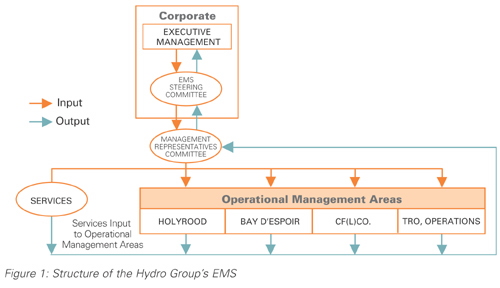
Corporate Management Area The Corporate Management Area consists of the leadership team and a committee of managers with responsibilities for facilities and operations with environmental aspects. The goal of this Management Area is to co-ordinate the development and maintenance of the overall Environmental Management System for Hydro and to identify environmental aspects appropriate to the leadership team’s activities and responsibilities. Although the operational and services Environmental Management System are managed independently, a common and consistent Corporate Environmental Policy and Guiding Principles sets the standard. Periodic reviews of activities and issues are conducted to ensure consistency with corporate standards. Under the goal to become an environmental leader, Hydro’s Senior Leadership Team developed the following corporate objectives:
In 2005, Hydro contracted Cantox Environmental Inc., a company with over 20 year’s experience in the field of toxicology risk assessment, to update the 1999 Human Health Risk Assessment on air emissions at the Holyrood plant. The assessment concluded that there are no long-term health effects from emissions from the plant, and that the likelihood of adverse health effects is considered to be low. Low likelihood means that the air quality conditions associated with the plant are not expected to lead to chronic health effects. Hydro communicated directly with stakeholders on the results, conclusions and recommendations of the updated Human Health Risk Assessment. Services Management Area Currently there are four groups within the Services Management Area that have environmental aspects identified. These groups include: Systems Operations and Customer Services, Engineering, Supply Chain Management and Environmental Services. In 2006, results included:
Thermal The Holyrood Thermal Generating Station is a 500 MW plant located in Holyrood, Conception Bay South. The Holyrood Thermal Generating Station’s Environmental Management System was initially registered in January 1999, and obtained re-registrations in 2002 and 2005. In 2006, The Holyrood Thermal Generating Station made progress on 13 EMPs, resulting in:
The Bay d’Espoir Management Area consists of seven existing generating stations on the island with an installed capacity of 604 MW. In 2006, some of the results included:
The Churchill Falls Hydroelectric Generating Station has an installed capacity of 5,428 MW. Associated with this development is approximately 1,200 km of high-voltage transmission lines, an airport and the Town of Churchill Falls. Environmental aspects of these facilities are included in the Environmental Management System. The environmental aspects of the decommissioned Twin Falls Hydroelectric Station are also managed through CF(L)Co’s Environmental Management System. The Environmental Management System was registered in 2000 and re-registered in 2003 and 2006. Some of the results of the 2006 Environmental Management Programs were:
The Transmission and Rural Operations (TRO) Division assets include: nine hydro-electric generating stations; one oil-fired plant; four gas turbines; three interconnected diesel generating stations; and, 21 isolated diesel generating and distribution systems. Hydro also maintains 54 high-voltage terminal stations, 25 lower-voltage interconnected distribution substations, 3,742 km of interconnected high-voltage transmission lines and 3,334 km of distribution lines. In 2006, significant accomplishments included:
|
||||||||||||||||||||||||||||||||||||||||||||||||||||||||||||||||||||||||||||||||||||||||||||||||||||||||||||||||||||||||||||||||||||||||||||||||||||||||||||||||
|
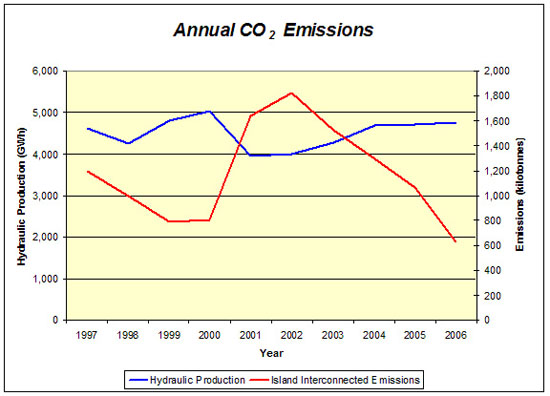
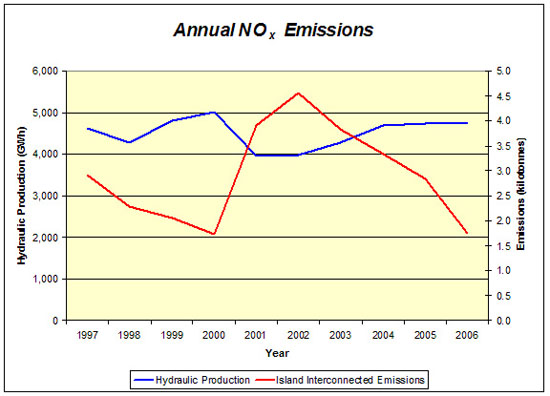
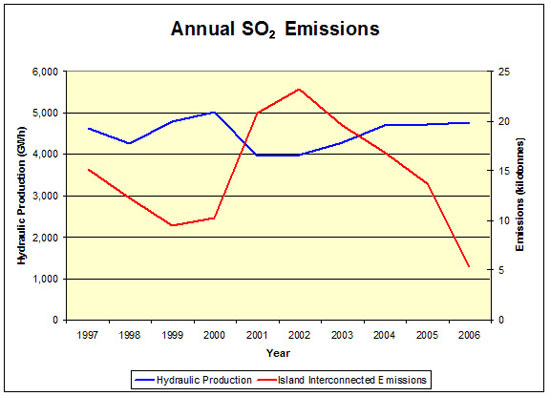
EMISSIONS A key measure of our impact on the environment is sulphur dioxide emissions from thermal generation. In 2006, we outperformed our target for reducing sulphur emissions at the Holyrood Thermal Generating Station, achieving almost a 60% reduction in emissions compared to 2005. Wastewater Control The Holyrood Thermal Generating Station’s wastewater treatment plant treats the wastewater resulting from the combustion of fuel and run-off from an on-site solid waste landfill. Components of the wastewater from the plant are measured and compared to regulatory limits. Once all aspects of the wastewater meet provincial regulatory requirements, the wastewater is released into the environment. In 2006, 5.56 million litres of wastewater was treated and discharged, which is a significant decrease from the 6.29 million litres of wastewater processed in 2005. This was primarily due to high reservoir storage conditions coupled with the closure of a major industrial customer late in 2005, which resulted in a significant adjustment to operating requirements on the Island Interconnected System. Thermal production was decreased to near minimum levels to allow maximized hydroelectric utilization. Air Quality Management Hydro relies on both hydroelectric and thermal generation to meet customer needs for electricity. The operation of the Holyrood Thermal Generating Station is highly dependent on the availability of water in Hydro’s hydroelectric reservoirs. Water levels in the reservoirs vary annually with the amount of precipitation and runoff. When water levels increase in the reservoirs, the demand on thermal generation decreases, as does associated air emissions. The opposite is also true. Total emissions were lower in 2006 than 2005 as a result of lower thermal production. Thermal production at the Holyrood Thermal Generation Station in 2006 reached one of its lowest production levels in approximately 20 years at 12% of the island’s energy requirements. This was in part due to an abundance of water to supply the hydro reservoirs and the shutdown of a large industrial customer in Stephenville. The thermal production change reduced overall emissions, but increased emissions intensity for both carbon dioxide (CO2) and nitrogen oxides (NOx) due to the impact on the operation of thermal units. Sulphur dioxide (SO2) total emissions and emissions intensity were significantly lower due to reduced loading level and a switch to 1% sulphur fuel in March of 2006. Total emissions for CO2, NOx and SO2 for the Holyrood Thermal Generating Station, gas turbines and isolated diesel generating stations are calculated using formula approved by the Department of Environment and Conservation. Emissions of CO2, NOx and SO2 for the isolated systems were 38,498 tonnes, 1,191 tonnes and 47 tonnes respectively. Emissions for the Island Interconnected System, which include the Holyrood Thermal Generating Station, and interconnected gas turbines and standby diesel plants are outlined in the following graphs. Note that the emissions for the Island Interconnected System are provided in kilotonnes, whereas those for the isolated systems, noted above, are in tonnes. This reflects the dominant affect of the Holyrood Thermal Generating Station on overall volumetric emissions from Hydro’s facilities.
Calculations of annual Suspended Particulate emissions from the Holyrood Thermal Generating Station are based on the unit emission rates derived from the most current stack emission testing, and are estimated using formula approved by the Department of Environment and Conservation. The latest stack emission testing was conducted in April 2005. Testing was completed under high load (target between the 85th and 95th percentile of the daily rates from the past three years). Average operating loads for Unit 1, Unit 2, and Unit 3 in 2006 were 76.9 MW, 64.7 MW and 69.1 MW respectively. The average operating load experienced in 2006 was considerably lower then the 2005 test load, therefore the particulate emission rates were prorated based on the average operating load. Suspended Particulate emissions from Hydro’s diesel generation stations, and gas turbine generation facilities, are based on unit emission rates and unit operating hours. Suspended Particulate emissions were also calculated using approved formula. In estimating Suspended Particulate emissions from gas turbines and diesel generators it is assumed that each unit operates at 100% load (full load) for every hour of operation. This is an extremely conservative estimate; as such an operating condition does not typically occur. The operating load of each gas turbine and diesel generator is dependent upon the load demand and the number of units operating at any given time. The total Suspended Particulate emissions for Holyrood Thermal Generating Station, diesel generators, and gas turbines was 607 tonnes. Approximately 93% or 564 tonnes came from Holyrood Thermal Generating Station and the remaining 7% or 43 tonnes were emitted from the diesel generators and gas turbine facilities. On March 21, 2006, Hydro started burning cleaner fuel at its Holyrood Thermal Generating Station. The switch from 2% to 1% sulphur fuel will significantly improve emissions from the plant. The cleaner fuel will decrease SO2 emission rates by 50% and reduce particulate emission rates by 40%. In 2007, stack sampling and air dispersion modelling will be performed at the plant to confirm the predicted reductions in SO2 and particulate emissions. Other Emission Reduction Initiatives Idling produces pollution through emissions of CO2, however, doing something as simple as turning off the vehicle’s engine can have an enormous impact on the environment. In support of this, Hydro’s corporate office in St. John’s (Hydro Place) has become an idle-free building. Anti-idling signs have been placed in various locations around the outside of the building to remind the general public, employees, suppliers and contractors to turn off their vehicle engines. Employees have also been asked to refrain from idling their vehicles in the parking lot. In 2007, Hydro is planning on expanding the idle-free program to other facility buildings throughout the province. Holyrood Thermal Generating Station Human Health Risk Assessment In 2004, Cantox Environmental Incorporated (CEI), a company with over 20 year’s experience in the field of toxicology risk assessment, in association with A.J. Chandler & Associates Limited was contracted by Hydro to update a Human Health Risk Assessment (HHRA) conducted in 1999 on air emissions from the Holyrood Thermal Generating Station. To conduct this updated study, additional information that was collected subsequent to the 1999 assessment, and other data which Hydro collected in response to the conclusions and recommendations made by CEI in the 1999 HHRA, were assessed. The updated 2004 HHRA concluded that there are no long-term health effects from emissions from the plant, and that the likelihood of adverse health effects is considered to be low. Low likelihood means that the air quality conditions associated with the plant are not expected to lead to chronic health effects. Short-term exceedances over health-based guidelines for criteria air contaminants may have occurred and could occur into the future. However, these exceedances have occurred infrequently in the past, and based on the available data are short-lived and would not be expected to result in any long-term health effects or permanent damage. Future increases in production would not be expected to result in chronic health effects, but the frequency of exceedances over short-term health-based guidelines could increase. The 1999 HHRA and the updated 2004 HHRA were conducted to determine if air emissions from the Holyrood Thermal Generating Station have adverse health effects on people living in nearby communities. Although not a regulatory requirement, Hydro involved provincial government Departments of Health and Environment and Conservation in the planning and implementation of these studies. Upon request of the community, the 2004 assessment was peer reviewed by Health Canada, who concluded that the assessment used appropriate and standard approaches that are based on sound science. The Department of Environment and Conservation coordinated the peer review by Health Canada, independent of Hydro. The assessment was also reviewed by the Departments of Environment and Conservation and, Health and Community Services. In June 2006, Hydro communicated directly with stakeholders on the results, conclusions and recommendations of the updated HHRA. Hydro informed the public upon the release of the report and posted the report and corresponding documents on its website. In addition, Hydro held small group information sessions with area residents, municipal leaders, local physicians and government officials to discuss the findings and recommendations of the HHRA and to listen to their concerns and address their questions. Hydro invited CEI to attend some of these sessions to provide a technical briefing to participants. |
||||||||||||||||||||||||||||||||||||||||||||||||||||||||||||||||||||||||||||||||||||||||||||||||||||||||||||||||||||||||||||||||||||||||||||||||||||||||||||||||
|
WASTE MANAGEMENT We are focused on recovering, reducing, reusing and recycling waste materials whenever feasible. PCBs Polychlorinated Biphenyls (PCB) is the most important waste management issue in the electric utility industry. This substance was commonly used in electrical equipment prior to the late 1970s, when PCB production was banned. The effect of this ban on Hydro and many other utilities was two-fold. The amount of PCB in service declined as new PCB-free equipment was installed and inventories of PCB-contaminated wastes increased as older equipment was retired. During the 1980s and 1990s, Hydro implemented significant initiatives to reduce risks associated with in-service equipment containing PCB. This included removal from service or decontamination of all transformers which had been manufactured with high concentrations of PCB. As well, all transformers filled with large volumes of PCB-contaminated oil were decontaminated. Some low-risk, older equipment, such as florescent light ballasts which contain small amounts of PCB, are managed to prevent any releases into the environment, and will remain in service for their life. A portion of older distribution equipment, currently in service, contains oil that is contaminated with low-level PCB. Hydro’s policy is to test this equipment for PCB contamination during emergency and planned maintenance, and collect all PCB contaminants for proper disposal. In 2006, two tonnes of low-level PCB material was placed in storage at Hydro’s Bishop’s Falls PCB waste storage facility. No low-level PCB material was removed from storage during 2006. As of December 31, 2006, there was two tonnes of low-level PCB material and no high-level PCB material in storage. This is depicted in Table 1.
Table 1: PCB material in storage and in service in 2005 and 2006. It is recognized that some older equipment such as capacitors and fluorescent light ballasts, which may contain high levels of PCB, remains in service. It is estimated that there is less than one tonne of PCB contained in this equipment. A portion of the older distribution transformers in service throughout the system contain oil that is contaminated with PCB to a level greater than 50 parts per million (ppm). Hydro has therefore initiated a program to reduce the amount of PCB-contaminated equipment in service. The multi-year program involves the identification, testing, and removal from service or refurbishment of all electrical equipment with a PCB level greater than 50 ppm. Table 2 provides an inventory of PCB material in storage and in service at Churchill Falls facilities as of December 31, 2006. At present, the total amount of low and high-level PCB material in storage in the Churchill Falls PCB waste storage facility is less than one tonne. There was less than one tonne of high and low PCB material sent for destruction in 2006. PCB material known to be in service are ballasts and capacitors; however, there is no inventory completed of this electrical equipment to date.
Table 2: PCB material in storage and in service in 2005 and 2006. Reuse and Recycling Initiatives Lubricating Oil Hydro currently has a waste oil management system for handling and disposing of various types of used oil. In the past, however, records on the amount and type of oil being reused and recycled were not always kept. Hydro has made significant progress over the last couple of years in this area. Hydro now records on an annual basis the amount of used base oil generated and new oil purchased at the company’s Diesel Generating Stations. In 2006, approximately 54,443 litres of used base oil was collected from these diesel stations for either recycling or reuse. At Hydro’s central maintenance facility in Bishop's Falls, approximately 67,000 litres of insulating oil was reused. Approximately 46,000 litres of this insulating oil was reused following processing or cleaning by internal forces, while 21,000 litres was reused following processing or cleaning by a third-party contractor. At CF(L)Co, approximately 31,570 litres of used lubricating oil, 3,280 litres of low-flash point liquids, 820 litres of paint, and 410 litres of grease were collected and disposed of by a third-party contractor for reuse or recycling in 2006. Approximately 187,000 litres of insulating oil was collected and disposed of by a third-party contractor for reuse or recycling. Wood Pole Line Management Program Hydro, as part of its transmission line network, manages approximately 26,000 poles of varying age. Wooden poles have an economic lifespan of about 40 years and an in-service lifespan of 50 years. With proper management, maintenance and refurbishment the life can be extended by at least 10 years or more. In Hydro's transmission system, just over one third of all poles are at or over 30 years and are reaching the end of their useful life. Core samples taken from some poles in 1998 indicated that the preservative retention level was not adequate. As a result, Hydro initiated a wood pole line management program in 2003 and it is expected to continue as a long-term asset management and life extension program. In 2006, Hydro treated 2,980 poles with boron rods. In 2006, 1,224 treated wood poles were removed from service; 24 were removed to landfills, while 1,200 were recycled. Disposal of Fuel Ash at Holyrood Thermal Generating Station Hydro has no flue gas desulphurization system nor does it have a fluidized bed combustion process. In earlier years, ash from the fuel oil used at the Holyrood Thermal Generating Station was sold for the vanadium content, but in recent years the combination of a lower vanadium content fuel specification and a drop in the market price of vanadium have eliminated this option. During 2006, all fuel ash was disposed of in an on-site, controlled solid waste landfill. The amount of total ash produced and disposed of at the landfill in 2006 was 201 tonnes. Scrap Metal Recycling and Reuse During 2006, Hydro decommissioned 398 distribution transformers, all of which were sold to a transformer manufacturer for reuse. Of the 398 transformers, 77 transformers with stainless steel tanks were re-furbished and shipped back to Hydro for reuse. In addition, approximately 70 tonnes of scrap aluminum/steel tower components and miscellaneous scrap were auctioned and recycled. Approximately 53 tonnes came from the Holyrood Thermal Generating Station facility, while the remainder came from Hydro's central maintenance facility in Bishop's Falls. Waste Audit and Landfill Diversion Options In 2006, to facilitate planning of activities aimed at diverting solid waste from the landfill, CF(L)Co engaged a consultant to identify and quantify solid waste streams and to develop options for waste diversion. Phase 1 of the study involved the identification and analysis of solid wastes generated at CF(L)Co by residential, commercial and industrial operations. Phase 2 involves the identification and implementation of waste diversion options, such as reduction alternatives, recycling and composting. Phase 2 will be completed during the first half of 2007. It is expected that the viable waste diversion alternatives will be implemented over the next few years. Construction Debris Removal Plan Revised In 2006, CF(L)Co management was requested by the Board of Directors to provide a status report on the extent of the remaining construction debris to be cleaned up and removed from abandoned construction camps that were used as part of the original construction of the Churchill Falls Project. The status report identified that the extent of the remaining cleanup was more significant than previously understood. It was concluded that given the geographic locations of some of the remaining sites and the relatively short season to perform removal, the construction debris removal project would still require significant time and financial resources for completion. Based on this, CF(L)Co proposed and received approval for additional funding for the next five years for site cleanups. Based upon progress and possible new discoveries during the five year program, a contingency was also allocated for a sixth year. For each of the next five years, CF(L)Co proposes to cleanup five large sites with the aid of contractors and five smaller sites with CF(L)Co personnel. |
||||||||||||||||||||||||||||||||||||||||||||||||||||||||||||||||||||||||||||||||||||||||||||||||||||||||||||||||||||||||||||||||||||||||||||||||||||||||||||||||
|
ENVIRONMENTAL SITE ASSESSMENT AND REMEDIATION We regularly report our environmental performance, commitments and activities to our stakeholders. In 2000, Hydro implemented an Environmental Site Assessment (ESA) program for all properties it owns or operates. The process followed is illustrated in Figure 6. The objectives of the ESA program are to:
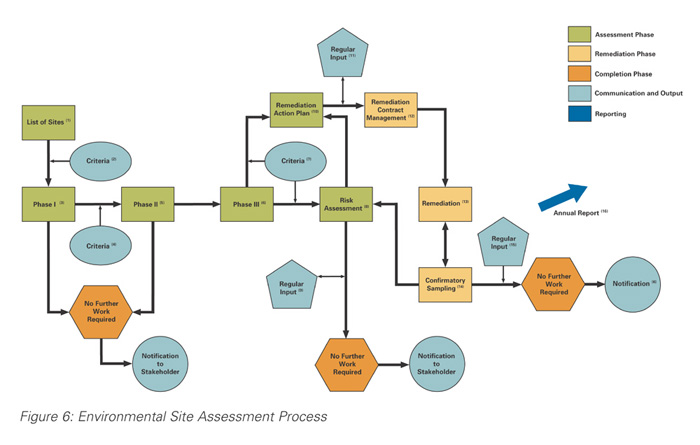
In 2000, Hydro implemented an ESA Program for all properties it currently owns or operates. The program initially focused on Prime Power Diesel Generating Facilities, which were regarded as having the highest potential for environmental contamination based on the annual throughput of potential contaminants. In 2006, Hydroelectric Operations were introduced to the program, with a Phase I ESA being completed at the hydroelectric generating station in Bay d’Espoir. In 2006, Hydro completed four Phase I Environmental Site Assessments, five Phase II Environmental Site Assessments and six Environmental Risk Assessments. The program has proven to be successful in identifying and managing the potential environmental contamination associated with Hydro's past and present operations. An additional five Phase I ESAs and nine Phase II ESAs are planned for 2007. In 2006, CF(L)Co completed six Phase I Environmental Site Assessments, six Phase II Environmental Site Assessments and six Environmental Risk Assessments. The program has proven to be successful in identifying and managing the potential environmental contamination associated with CF(L)Co's past and present operations. An additional five Phase I ESAs and five Phase II ESAs are planned for 2007.
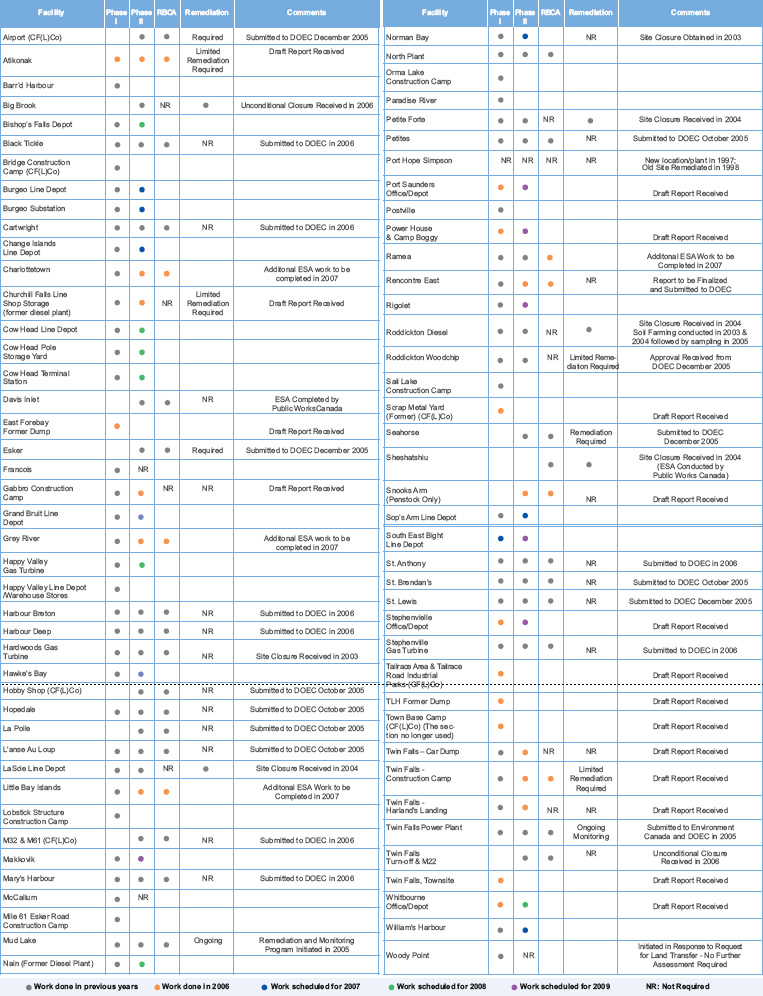
Phase l – review of information and records, site visit, and interviews
Phase II – characterization of a site for physical aspects and potential contamination Risk-based corrective action (RBCA) – a methodology that identifies a site-specific target level of contamination that has an acceptable risk to human health Remediation – site cleanup to a specified regulatory standard Table 3 below shows the ESA work that was accomplished in 2006 and future plans, if any for each site.
|
||||||||||||||||||||||||||||||||||||||||||||||||||||||||||||||||||||||||||||||||||||||||||||||||||||||||||||||||||||||||||||||||||||||||||||||||||||||||||||||||
|
SPILLS AND OTHER INCIDENTS We maintain a state of preparedness in order to respond quickly and effectively to environmental emergencies. The very nature of the work involved to generate and transmit electricity requires handling and use of a variety of potential environmental contaminants such as fuel oils, lubricating oils and chemicals. In 2006, Hydro used approximately 15 million litres of diesel fuel and 200 million litres of No. 6 fuel oil to generate electricity. As part of standard operating procedures, Hydro strives to reduce the potential for leaks and spills. However, incidents can occur and are most often the result of equipment failure, unanticipated hazards, and occasionally, human error. Being prepared for such an incident is critical to mounting a quick and effective response to minimize impacts on people and the environment. Hydro has developed Environmental Emergency Response Plans (EERP) to quickly, effectively and safely deal with such incidents. Within Hydro, all personnel who handle or work around petroleum products receive training related to the EERP and, when applicable, specific operating procedures have been developed to facilitate the safe handling of the products used. Hydro had seven reportable spill and leak incidents in 2006. Two of these entered a water body, however the volumes were very small (both were less than one litre each). The approximate volume for all reportable spills was 747 litres, up from 160 litres in 2005. All reportable spills involved petroleum products or its derivatives, with 87.8% being non-PCB-contaminated transformer oil, 12% jet fuel and 0.2% bearing oil. CF(L)Co had three reportable spills in 2006, two of which entered water bodies. The total volume of oil spilled and leaked was 151 litres of petroleum type products. The total volume of liquid reportable spills cleaned up is estimated. The estimations are based on 100% recovery of spills or leaks on soil. In all spills from our distribution system, Hydro recovered contaminated soil and verified, through sampling, that the level remaining was within acceptable levels. |
||||||||||||||||||||||||||||||||||||||||||||||||||||||||||||||||||||||||||||||||||||||||||||||||||||||||||||||||||||||||||||||||||||||||||||||||||||||||||||||||
|
SPECIES AND HABITAT DIVERSITY We respect the cultural heritage of the people of the province and strive to minimize the potential impact of company activities on heritage resources. CF(L)Co has existing transmission, generation and control facilities within the range of both the Lac Joseph and Red Wine Mountains caribou herds. The proposed Lower Churchill Hydroelectric Generation Project also falls within the range of these sedentary woodland caribou herds which were designated as "threatened" in 2001 by the Committee on the Status of Endangered Wildlife in Canada (COSEWIC) designated the herds as "threatened" under the federal Species at Risk Act (SARA). The Provincial Minister of the Department of Environment and Conservation also designated these herds as "threatened" under the provincial Species at Risk Act in July, 2002. To demonstrate Hydro’s commitment to addressing Species at Risk issues, the company has a representative participating on the Labrador Woodland Caribou Recovery Team. In 2006, Hydro’s participation on the Labrador Woodland Caribou Recovery Team continued. Specifically, the Team has been focused on defining critical habitat for inclusion in the Recovery Action Plan which is scheduled for completion by the end of 2007. Fisheries Compensation Water Releases In 2006, Hydro, as part of long-term agreements with the Department of Fisheries and Oceans released approximately 125 MCM (million cubic metres) of water at its fisheries compensation facilities. The water released at White Bear River, Grey River, Granite Canal, Upper Salmon and Hind's Lake was performed at critical times through the year for habitat protection and fish migration. In comparison, the amount of thermal production required to offset the amount released was 30 gigawatt hours (GWh). Given the relationship between thermal and hydroelectric generation on the Island Interconnected System, the thermal conversion rate and average cost of fuel, the equivalent value of the water released at all fisheries compensation facilities was approximately $2.6 million. It also resulted in 163 tonnes of sulphur dioxide emissions and 25,000 tonnes of carbon dioxide emissions. |
||||||||||||||||||||||||||||||||||||||||||||||||||||||||||||||||||||||||||||||||||||||||||||||||||||||||||||||||||||||||||||||||||||||||||||||||||||||||||||||||
|
ALTERNATIVE ENERGY: WIND We took significant steps toward the future integration of wind generation into our provincial electricity system through the awarding of two contracts for over 50 megawatts of wind power on the island. Newfoundland and Labrador has a world-class wind resource. Wind power is a clean, stable, cost-effective source of energy and Hydro has been making a lot of progress to tap this valuable energy source. Hydro operates three separate systems in the province. The Island Interconnected System; the Labrador Interconnected System; and the Isolated Diesel Systems, of which there are 21 isolated communities powered by diesel generation systems located in remote coastal communities around the province. In 2006, Hydro took some significant steps toward the integration of wind generation into the provincial electricity system and looked closely at the opportunities that exist to incorporate wind power into each of these separate systems. The strategy for each is a unique as the province, with a different focus in each of the three regions. Island of Newfoundland Currently, the Island Interconnected System is isolated from the North American grid and has an existing generating capacity of 1,919 MW provided by approximately 65% hydroelectric and 35% fossil fuel generation. Wind power on the island electricity system plays an important energy and environmental role. However, because the island system is not connected to the mainland, there is limited potential to incorporate large amounts of wind energy into this system. The focus for wind power generated on the island is to supplement Hydro’s existing energy supply and help reduce our reliance on thermal generation. In late 2006, Hydro awarded two contracts to provide over 50 MW of wind power to the island -27 MW in St. Lawrence and another 24 MW in Fermeuse. Hydro expects both projects to be in service by early 2009. Both projects will allow Hydro to reduce fossil-fired generation at the Holyrood Thermal Generating Station (Holyrood Thermal Generating Station). Annually, the environmental impacts from the wind projects will include:
Labrador has a significant wind resource and development potential for thousands of megawatts. The development of this resource presents different opportunities from that on the island. Since Labrador is connected to the North American electricity grid, the focus of wind energy in Labrador could be for both domestic use and for export. In December, 2006 Hydro installed four wind monitoring towers near Churchill Falls in an area known as Ranger Lake to assess the potential of the wind resource in the area of the Smallwood Reservoir in Labrador. Monitoring will provide valuable input to determining the potential of the resource and the feasibility of development. Hydro is examining the wind potential from a system perspective including interconnection, power purchase agreements and technical integration issues, including integration with the Lower Churchill Project. Isolated Diesel Systems The remote island community of Ramea, on the South Coast of Newfoundland, has been the location of a pilot project with wind and diesel generation since 2004. Building on this existing system in Ramea, Hydro is undertaking a research and development project to incorporate hydrogen to develop an environmentally-friendly energy solution to be used in small, isolated electrical distribution systems. Since September 2004, Hydro has purchased almost 800,000 kilowatt hours of energy from the wind pilot project, offsetting over 216,000 litres of fuel. Hydro relies on diesel-fuelled generation systems to provide power to 21 small, coastal systems across the province. Since 2004, the remote island community of Ramea, on the South Coast of Newfoundland, has been the location of a pilot project with wind and diesel generation. Since then, Hydro has purchased almost 800,000 kilowatt hours (kWh) of energy from Frontier Power Systems and offset over 216,000 litres of fuel. Building on this existing, successful wind-diesel system in Ramea, Hydro has begun a five-year research and development project to integrate hydrogen with wind power and diesel generation. This project is focused on developing an environmentally-friendly energy solution to be used in small, isolated electrical distribution systems. This unique energy project has the potential to significantly reduce Hydro’s reliance on diesel generation to provide clean, renewable energy to its isolated customers. A successful project will produce a reliable and consistent energy supply and help reduce greenhouse gases and other emissions associated with diesel generation. |
||||||||||||||||||||||||||||||||||||||||||||||||||||||||||||||||||||||||||||||||||||||||||||||||||||||||||||||||||||||||||||||||||||||||||||||||||||||||||||||||
|
CONSERVATION We strengthened our energy conservation commitment by hiring a new Energy Conservation Program Manager to work with our partners to promote a coordinated province-wide approach to conservation education, awareness and programming. Hydro has a responsibility to steward the province’s natural resources and this drives the company’s commitment to energy conservation. In 2006, Hydro strengthened its focus on conservation and is leading a coordinated approach with other stakeholders for conservation education and awareness. Through HYDROWISE, Hydro’s energy conservation program, the company launched a new energy efficiency website and provided rebates and financing for home insulation upgrades. In 2007, Hydro will complete a conservation demand potential study with Newfoundland Power which will serve as a foundation to a longer-term conservation strategy. Award Winning Conservation Program In 2006, Hydro’s HYDROWISE Energy Conservation School Pilot Program received a Pinnacle Award of Excellence from the International Association of Business Communications (IABC) NL Chapter. The Pinnacle Awards recognize outstanding communications work. The HYDROWISE School Pilot Program received an award in the community relation category, which focuses on communications programs or campaigns targeted at maintaining or improving an organization’s presence, image, and relationship among community audiences, governing bodies or agencies. The HYDROWISE Energy Conservation School Pilot Program was aimed at educating Grade 2 and 3 students about energy conservation. The fun and interactive program was piloted at Bay d’Espoir Academy in the fall of 2005. Integrated into the class curriculum, teachers were given a kit of resources to lead their class through a series of “Secret Missions” designed to take them from Agents in Training to HYDROWISE Special Agents. Wrap Up for Savings In October 2006, Hydro launched the HYDROWISE Wrap Up for Savings program to help customers save energy and lower their heating costs. The Wrap Up for Savings program provides rebates and financing for insulation upgrades for basements, crawl spaces, attics and external walls in electrically heated homes. HYDROWISE.ca relaunched Since 2002, HYDROWISE has been bringing information to Hydro’s customers on easy ways to conserve electricity and save on their energy bills. In 2006, the HYDROWISE program distributed information kits to customers through trade shows, workshops, bill inserts and the internet. During 2006, Hydro relaunched its HYDROWISE website. The website was updated with new energy conservation and efficiency information and easy and helpful tips to help customers save energy. The website is a valuable resource and is part of Hydro’s overall leadership role in helping all electricity users conserve and save energy. |
||||||||||||||||||||||||||||||||||||||||||||||||||||||||||||||||||||||||||||||||||||||||||||||||||||||||||||||||||||||||||||||||||||||||||||||||||||||||||||||||
|
PARTNERSHIPS Our new Community Investment Program is focused on supporting communities and charities in two key areas: Safety and Health, and, Environment and Conservation. Conservation Corps of Newfoundland and Labrador - Green Team Hydro sponsored two projects during the summer of 2006, enabling the Conservation Corps of Newfoundland and Labrador to strengthen its programming in Labrador. The Cartwright Green Team participated in an experimental peat moss transfer along the Trans-Labrador Highway. The Team received in-depth training from a botanist as well as continued support from a biology intern on the transfer of peat moss from donor sites to designated experimental sites. This project aimed to complement an earlier project in peat moss transfer that began in Mary’s Harbour in 2004. In addition, the Team developed, created and placed signage around the town outlining and explaining the work completed. Part Two of this project was the creation of a community garden. The Team completed their summer by handing the community garden over to local residents to be enjoyed by everyone. The Forteau Green Team spent most of their summer knee deep in a number of local brooks and rivers. Before work began, the Team received training in testing methods from a Department of Fisheries and Oceans employee. They were responsible for completing water quality testing, which involved water temperature, flow speed, silt levels, as well as a flora and fauna inventory. In addition to testing, the Team involved the whole town in a community wide river clean up. Not only did the Team work in the river, they improved the local trail system through debris removal, boardwalk construction and brush cutting. The public education component of the project was accomplished though public notices and conducting the Environmental Awareness Day workshop for the public. The Team ended their summer with participation in the Forteau Come Home Year celebration where they distributed information about their project as well as other environmental information. Hydro-DFO Conjoint Work in 2006: Origin of Spawners Utilizing Compensation Creek, Granite Canal Hydroelectric Project The Granite Canal Hydroelectric Development, located within the Bay d’Espoir - Upper Salmon Hydroelectric Generating System, was developed to generate up to 40 megawatts of electricity. Construction of the project resulted in the destruction of salmonid spawning and rearing habitat utilized primarily by ouananiche (Salmo salar) and, to a lesser extent, brook trout (Salvelinus fontinalis). To compensate for habitat losses, Hydro constructed a highly engineered fish habitat channel, subsequently named Compensation Creek, which included side channels as ‘off channel’ habitats intended primarily for brook trout. Effectiveness of this compensatory habitat has been monitored over the last three years. Pre-development surveys suggested that the habitat affected by the project, i.e., the previous outlet of Granite Canal, was used extensively for spawning, particularly by ouananiche. Additionally, there is very limited habitat available for spawning in tributary streams in Maelpaeg Lake. Consequently, Compensation Creek, supplemented by possible spawning along shoals on Maelpaeg Lake and islands are supplying all of the recruitment for Maelpaeg Lake fish populations. In the summer of 2006, when mature ouananiche were widely distributed throughout Maelpaeg Lake, fish were captured by fyke net from locations throughout the lake by the Department of Fisheries and Oceans Canada (DFO). Two hundred and thirty seven ouananiche and 27 brook trout were surgically implanted with a 23.1 mm PIT (passive integrated transponder) tags additionally 26 ouananiche and nine brook trout were surgically implanted with radio transmitters. After post-operative recovery, the fish were released back into the lake close to their point of capture. Double gate loop PIT antennae, attached to PIT tag readers/data loggers were installed at the weir at the entrance to Compensation Creek to record tagged fish entering Compensation Creek. A radio telemetry receiver also recorded radio tagged fish that both entered the creek and also migrated to the tailrace area but did not enter the creek. These two systems provided DFO with the times that individual fish entered and exited the creek. A helicopter survey of the lake and nearby rivers and streams was also conducted to determine locations of the fish that did not enter the creek. The PIT gate will be re-established in summer 2007 to address whether ouananiche are consecutive/repeat spawners or if there is evidence of alternative year spawning. Validation of Bio-engineering Design and Determination of ‘Habitat Productive Capacity’ in Compensatory Habitat Fluvial habitat compensation in Newfoundland and Labrador has largely been addressed on a quantitative basis (1:1 replacement ratio of habitat units, 100 m2). It has become apparent that for habitat compensation to be effective it is necessary to consider both habitat quantity and ‘quality’ in implementation and assessment. The main purpose of the study was to address how habitat quality fits into the overall compensation strategy. To achieve this goal, the bioengineering design of the compensatory habitat within the side channels of Compensation Creek was evaluated. Fine scale use of habitat features in the compensatory habitat and a natural stream were compared for both salmonid populations and benthic macroinvertebrates. Salmonid population estimates were conducted by the DFO in both side channels of Compensation Creek (three sites per channel) and a nearby natural stream (three sites) in July and October of 2006. Individual fish were weighed, measured, and selected fish were surgically implanted with a 23.1 mm PIT tag. This information will allow the calculation of habitat based production estimates as well as individual growth rates. At each fish location, detailed microhabitat data (depth, velocity, substrate, cover, proximity to bank and cover features, water quality) was collected to aid in future analysis. During the fall sampling period, benthic macroinvertebrate samples were collected from the individual habitat structures (snags) and the stream bottom within the side channels as well as the natural stream. This information will add to the habitat data for the fish sampling as well as evaluate the role these habitat structures play in overall benthic macroinvertebrate production and diversity. The benthic macroinvertbrate portion of this project will form the basis of a Masters of Environmental Sciences major project paper. Hydro assisted DFO in development of the approach for both studies, provided equipment to perform the scientific portions of the studies (PIT tags, radio transmitters, loop PIT antennae, and PIT tag readers/data loggers), accommodations at the Granite Canal site during the study periods and a secure staging area for the equipment used to undertake the studies. DFO provided the technical expertise, equipment to perform the study (watercraft, nets, etc), collection, extrapolation and interpretation of the data and the preparation of draft reports. Hydro and DFO have been performing conjoint work with freshwater species over the past 25 years. This ‘value added research’ will assist Hydro and DFO in better understanding fish populations in the Granite Canal watershed. |
||||||||||||||||||||||||||||||||||||||||||||||||||||||||||||||||||||||||||||||||||||||||||||||||||||||||||||||||||||||||||||||||||||||||||||||||||||||||||||||||