|
|
|
PARTNERSHIPS
 Our new Community Investment Program is focused on supporting communities and charities in two key areas: Safety and Health, and, Environment and Conservation.
Conservation Corps of Newfoundland and Labrador - Green Team
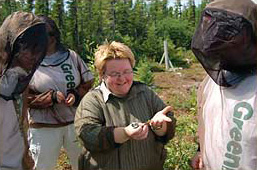
Hydro sponsored two projects during the summer of 2006, enabling the Conservation Corps of Newfoundland and Labrador to strengthen its programming in Labrador.
The Cartwright Green Team participated in an experimental peat moss transfer along the Trans-Labrador Highway. The Team received in-depth training from a botanist as well as continued support from a biology intern on the transfer of peat moss from donor sites to designated experimental sites. This project aimed to complement an earlier project in peat moss transfer that began in Mary’s Harbour in 2004. In addition, the Team developed, created and placed signage around the town outlining and explaining the work completed. Part Two of this project was the creation of a community garden. The Team completed their summer by handing the community garden over to local residents to be enjoyed by everyone.
The Forteau Green Team spent most of their summer knee deep in a number of local brooks and rivers. Before work began, the Team received training in testing methods from a Department of Fisheries and Oceans employee. They were responsible for completing water quality testing, which involved water temperature, flow speed, silt levels, as well as a flora and fauna inventory. In addition to testing, the Team involved the whole town in a community wide river clean up. Not only did the Team work in the river, they improved the local trail system through debris removal, boardwalk construction and brush cutting. The public education component of the project was accomplished though public notices and conducting the Environmental Awareness Day workshop for the public. The Team ended their summer with participation in the Forteau Come Home Year celebration where they distributed information about their project as well as other environmental information.
Hydro-DFO Conjoint Work in 2006: Origin of Spawners Utilizing Compensation Creek, Granite Canal Hydroelectric Project
The Granite Canal Hydroelectric Development, located within the Bay d’Espoir - Upper Salmon Hydroelectric Generating System, was developed to generate up to 40 megawatts of electricity. Construction of the project resulted in the destruction of salmonid spawning and rearing habitat utilized primarily by ouananiche (Salmo salar) and, to a lesser extent, brook trout (Salvelinus fontinalis). To compensate for habitat losses, Hydro constructed a highly engineered fish habitat channel, subsequently named Compensation Creek, which included side channels as ‘off channel’ habitats intended primarily for brook trout. Effectiveness of this compensatory habitat has been monitored over the last three years.
Pre-development surveys suggested that the habitat affected by the project, i.e., the previous outlet of Granite Canal, was used extensively for spawning, particularly by ouananiche. Additionally, there is very limited habitat available for spawning in tributary streams in Maelpaeg Lake. Consequently, Compensation Creek, supplemented by possible spawning along shoals on Maelpaeg Lake and islands are supplying all of the recruitment for Maelpaeg Lake fish populations.
In the summer of 2006, when mature ouananiche were widely distributed throughout Maelpaeg Lake, fish were captured by fyke net from locations throughout the lake by the Department of Fisheries and Oceans Canada (DFO). Two hundred and thirty seven ouananiche and 27 brook trout were surgically implanted with a 23.1 mm PIT (passive integrated transponder) tags additionally 26 ouananiche and nine brook trout were surgically implanted with radio transmitters. After post-operative recovery, the fish were released back into the lake close to their point of capture.
Double gate loop PIT antennae, attached to PIT tag readers/data loggers were installed at the weir at the entrance to Compensation Creek to record tagged fish entering Compensation Creek. A radio telemetry receiver also recorded radio tagged fish that both entered the creek and also migrated to the tailrace area but did not enter the creek. These two systems provided DFO with the times that individual fish entered and exited the creek. A helicopter survey of the lake and nearby rivers and streams was also conducted to determine locations of the fish that did not enter the creek. The PIT gate will be re-established in summer 2007 to address whether ouananiche are consecutive/repeat spawners or if there is evidence of alternative year spawning.
Back to Top
Validation of Bio-engineering Design and Determination of ‘Habitat Productive Capacity’ in Compensatory Habitat
Fluvial habitat compensation in Newfoundland and Labrador has largely been addressed on a quantitative basis (1:1 replacement ratio of habitat units, 100 m2). It has become apparent that for habitat compensation to be effective it is necessary to consider both habitat quantity and ‘quality’ in implementation and assessment. The main purpose of the study was to address how habitat quality fits into the overall compensation strategy. To achieve this goal, the bioengineering design of the compensatory habitat within the side channels of Compensation Creek was evaluated.
Fine scale use of habitat features in the compensatory habitat and a natural stream were compared for both salmonid populations and benthic macroinvertebrates. Salmonid population estimates were conducted by the DFO in both side channels of Compensation Creek (three sites per channel) and a nearby natural stream (three sites) in July and October of 2006. Individual fish were weighed, measured, and selected fish were surgically implanted with a 23.1 mm PIT tag. This information will allow the calculation of habitat based production estimates as well as individual growth rates. At each fish location, detailed microhabitat data (depth, velocity, substrate, cover, proximity to bank and cover features, water quality) was collected to aid in future analysis.
During the fall sampling period, benthic macroinvertebrate samples were collected from the individual habitat structures (snags) and the stream bottom within the side channels as well as the natural stream. This information will add to the habitat data for the fish sampling as well as evaluate the role these habitat structures play in overall benthic macroinvertebrate production and diversity. The benthic macroinvertbrate portion of this project will form the basis of a Masters of Environmental Sciences major project paper.
Hydro assisted DFO in development of the approach for both studies, provided equipment to perform the scientific portions of the studies (PIT tags, radio transmitters, loop PIT antennae, and PIT tag readers/data loggers), accommodations at the Granite Canal site during the study periods and a secure staging area for the equipment used to undertake the studies. DFO provided the technical expertise, equipment to perform the study (watercraft, nets, etc), collection, extrapolation and interpretation of the data and the preparation of draft reports. Hydro and DFO have been performing conjoint work with freshwater species over the past 25 years. This ‘value added research’ will assist Hydro and DFO in better understanding fish populations in the Granite Canal watershed.
|
|
|