|
|
|
ENVIRONMENTAL MANAGEMENT SYSTEMS
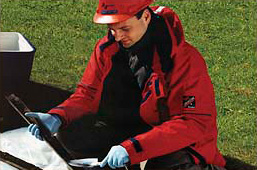 Our commitment to environmental leadership can be seen across our business through our ISO 14001 certified Environmental Management System.
In 2006, with a renewed mandate and refocused organization, Hydro set strategic goals to guide its business into the future. One of those goals highlights the organization’s ongoing and continued commitment to environmental responsibility.
Goal: To Be an Environmental Leader
As a company and a member of the community, Hydro has a responsibility to protect the environment. The company’s commitment to environmental leadership can be seen across the business through its ISO 14001 certified Environmental Management System. Hydro’s Environmental Management System and ISO 14001 certification are key components of this commitment and they will continue to be the cornerstone of the company’s environmental work.
Hydro’s structured and consistent management approach to dealing with environmental issues facing Hydro has proven to be successful, and the company has committed to continue to build on the success achieved in 2006.
Hydro’s Environmental Management Systems provide the company with a solid framework for environmental management and continual improvement. Hydro is committed to managing its operations to reduce its environmental impact, while balancing its mandate to provide customers with safe, reliable, least-cost power. All Hydro divisions have been ISO 14001 certified since 2004, and this gives added assurance to all stakeholders of continued environmental excellence.
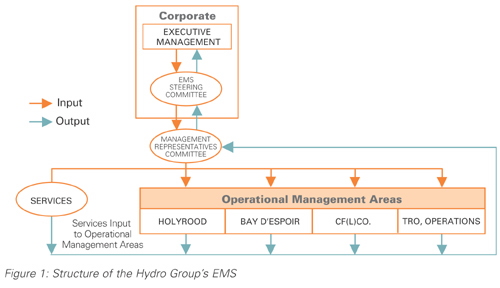
The six designated management areas (Figure 1) within Hydro manage their environmental aspects through Environmental Management Systems consistent with ISO 14001. Each Environmental Management System is certified and registered by a third party, Quality Management Institute. In 2006, Hydro continued to show improvements on environmental Key Performance Indicators, electronic Environmental Management System documentation, Environmental Management System surveillance audits and reporting to executive management on Environmental Management System target performance.
Hydro’s Transmission and Rural Operations Division, Hydro Generation Division and Churchill Falls (Labrador) Corporation were successful in receiving recertification following audits by our Registrar. General accomplishments resulting from the Environmental Management Programs (EMP) in each of the Management Areas in 2006 are detailed in this section.
Back to Top
Corporate Management Area
The Corporate Management Area consists of the leadership team and a committee of managers with responsibilities for facilities and operations with environmental aspects. The goal of this Management Area is to co-ordinate the development and maintenance of the overall Environmental Management System for Hydro and to identify environmental aspects appropriate to the leadership team’s activities and responsibilities. Although the operational and services Environmental Management System are managed independently, a common and consistent Corporate Environmental Policy and Guiding Principles sets the standard. Periodic reviews of activities and issues are conducted to ensure consistency with corporate standards.
Under the goal to become an environmental leader, Hydro’s Senior Leadership Team developed the following corporate objectives:
- displace 200,000 barrels of oil by 2009 by increasing use of renewable energy sources;
- decrease sulphur dioxide (SO2) emissions at the Holyrood Thermal Generating Station; and,
- increase the number of Senior Leadership Team approved Environmental Management System targets and objectives accomplished.
Out of these objectives, four targets were identified in the Corporate Management Area in 2006. These were:
- increase the number of leadership team approved Environmental Management System targets and objectives accomplished within the Hydro Group from 75% to 90% in 2006;
- approve and begin feasibility study for large-scale wind developments in Labrador;
- select proponent and execute power purchase agreement for a 25 MW wind project on the island; and,
- decrease SO2 emissions at the Holyrood Thermal Generating Station by 30% in 2006 (1.68 tonnes of SO2 per GWh).
In support of decreasing SO2 emissions, Hydro started burning cleaner fuel at its Holyrood Thermal Generating Station. The switch from 2% to 1% sulphur fuel will significantly improve emissions from the plant. The lower-sulphur fuel will decrease annual SO2 emissions by 50%, reduce particulate emissions by up to 40% and will assist Hydro in its environmental compliance requirements. In 2007, stack sampling and air dispersion modelling will be performed at the plant to confirm our predicted reductions in SO2 and particulate emissions.
In 2005, Hydro contracted Cantox Environmental Inc., a company with over 20 year’s experience in the field of toxicology risk assessment, to update the 1999 Human Health Risk Assessment on air emissions at the Holyrood plant. The assessment concluded that there are no long-term health effects from emissions from the plant, and that the likelihood of adverse health effects is considered to be low. Low likelihood means that the air quality conditions associated with the plant are not expected to lead to chronic health effects. Hydro communicated directly with stakeholders on the results, conclusions and recommendations of the updated Human Health Risk Assessment.
Back to Top
Services Management Area
Currently there are four groups within the Services Management Area that have environmental aspects identified. These groups include: Systems Operations and Customer Services, Engineering, Supply Chain Management and Environmental Services.
In 2006, results included:
- awarding two contracts to provide over 50 megawatts (MW) of wind power to the Island Interconnected System;
- the construction of wind monitoring towers to measure the wind resource in Labrador to determine its potential;
- undertaking a research and development project to incorporate hydrogen generation in the existing wind/diesel generation pilot project in Ramea;
- Hydro’s Hydrowise Energy Conservation School Pilot Program receiving an Award of Excellence at the International Association of Business Communications (IABC) NL Chapter. The Hydrowise School Pilot Program received an award in the community relation category, which focuses on communications programs or campaigns targeted at maintaining or improving an organization’s presence, image, and relationship among community audiences, governing bodies or agencies;
- Hydro’s head office in St. John’s (Hydro Place) became an idle-free building;
- as part of long-term agreements with the Department of Fisheries and Oceans for fish and fish habitat protection, approximately 125 MCM of water was released at fisheries compensation facilities;
- ongoing progress made on a program to improve load efficiencies at Holyrood Thermal Generating Station and Hydro Generation;
- Hydroelectric Operations were introduced to the Environmental Site Assessment program, with a Phase I Environmental Site Assessment being completed at the Hydroelectric Generating Station in Bay d’Espoir. Hydro completed four Phase I Environmental Site Assessments, five Phase II Environmental Site Assessments and six Environmental Risk Assessments; and,
- the SF6 Management Program and the Granite Canal Fisheries Habitat Implementation Program was completed.
Back to Top
Operational Management Areas
Thermal
The Holyrood Thermal Generating Station is a 500 MW plant located in Holyrood, Conception Bay South. The Holyrood Thermal Generating Station’s Environmental Management System was initially registered in January 1999, and obtained re-registrations in 2002 and 2005.
In 2006, The Holyrood Thermal Generating Station made progress on 13 EMPs, resulting in:
- an improvement in efficiency of the conversion of fuel energy and associated reduction in selected emissions intensities;
- development of noise emissions and waste management plans;
- completion of a study on the control of regeneration wastes;
- implementation of an emissions reduction strategy and reduction in sulphur content in fuel from 2% to 1%;
- personnel at the Holyrood Thermal Generating Station and Eastern Canada Response Corporation (ECRC) participated in a conjoint drill to practice oil spill response;
- completion of year two of a three-year program to remove all friable asbestos. The total cost of the 2006 program was approximately $3.8 million; and,
- continued removal of PCB waste and recycling of scrap metal.
Hydro Operations
The Bay d’Espoir Management Area consists of seven existing generating stations on the island with an installed capacity of 604 MW.
In 2006, some of the results included:
- as a way to minimize the risk associated with handling 205 litre drums of waste oil, six waste oil storage tanks were installed at various facilities within Hydro Generation;
- implementation of a new bulk fuel monitoring system at the Cat Arm Hydroelectricity facility;
- switch to an environmentally-friendly lubricant on the wicket gates at the main powerhouse at the Bay d'Espoir Generating Facility;
- replacement of an aging wooden creosote treated penstock at the Snook’s Arm Generating Station to a steel penstock;
- delivery of several Environmental Awareness training sessions; and,
- development and delivery of an awareness program to promote conservation of electricity within buildings.
Back to Top
Churchill Falls (Labrador) Corporation (CF(L)Co)
The Churchill Falls Hydroelectric Generating Station has an installed capacity of 5,428 MW. Associated with this development is approximately 1,200 km of high-voltage transmission lines, an airport and the Town of Churchill Falls. Environmental aspects of these facilities are included in the Environmental Management System. The environmental aspects of the decommissioned Twin Falls Hydroelectric Station are also managed through CF(L)Co’s Environmental Management System. The Environmental Management System was registered in 2000 and re-registered in 2003 and 2006.
Some of the results of the 2006 Environmental Management Programs were:
- continued use of environmentally-friendly wicket gate grease and transformer oil, with 11 of 11 turbines and eight of 11 transformers converted to environmentally-friendly products to date;
- a monitoring program to ensure ability to prioritize maintenance for turbine units that experienced the highest oil losses. One turbine unit is repaired per year;
- completed six Phase I Environmental Site Assessments, six Phase II Environmental Site Assessments and six Environmental Risk Assessments;
- replaced deteriorated oil gaskets on three switchyard transformers;conducted a field program in the Churchill Falls watershed to measure greenhouse gas fluxes (carbon dioxide, methane and nitrogen dioxide);
- an assessment of all CF(L)Co. fuel systems were completed in 2006 to develop a comprehensive report on the structure and operation of each of the current fuel systems and to identify areas for environmental protection improvements;
- the process to identify and quantify solid waste streams and to develop options for waste diversion; and,
- replaced two aging fuel storage tank systems at water control structures.
Back to Top
Transmission and Rural Operations
The Transmission and Rural Operations (TRO) Division assets include: nine hydro-electric generating stations; one oil-fired plant; four gas turbines; three interconnected diesel generating stations; and, 21 isolated diesel generating and distribution systems. Hydro also maintains 54 high-voltage terminal stations, 25 lower-voltage interconnected distribution substations, 3,742 km of interconnected high-voltage transmission lines and 3,334 km of distribution lines.
In 2006, significant accomplishments included:
- updates to the five-year plan for improvements to prevent potential environmental impacts from fuel storage systems;
- development of a detailed test plan for electrical equipment potentially containing PCBs and implementation of a records management process;
- continuation of a study for alternate forms of herbicide applications to reduce the use of herbicides for vegetation control;
- continued environmental assessments of properties that may have sensitivities to herbicide application;
- delivery of Environmental Sensitivity refresher training to all linecrew personnel;
- continued with the collection of information related to environmental sensitivities for new transmission and distribution lines in TRO Central, Northern and Labrador; and,
- ongoing success with the wooden pole reuse program with respect to tracking treated-wood material removed from service, recycled, reused, stored or disposed.
|
|
|