|
|
|
EMISSIONS
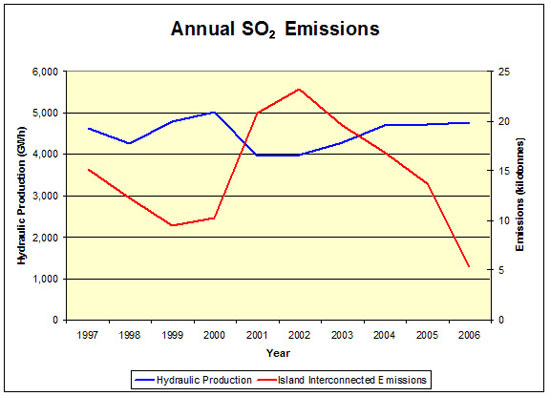
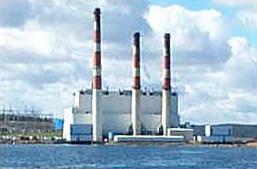 A key measure of our impact on the environment is sulphur dioxide emissions from thermal generation. In 2006, we outperformed our target for reducing sulphur emissions at the Holyrood Thermal Generating Station, achieving almost a 60% reduction in emissions compared to 2005.
Wastewater Control
The Holyrood Thermal Generating Station’s wastewater treatment plant treats the wastewater resulting from the combustion of fuel and run-off from an on-site solid waste landfill. Components of the wastewater from the plant are measured and compared to regulatory limits. Once all aspects of the wastewater meet provincial regulatory requirements, the wastewater is released into the environment. In 2006, 5.56 million litres of wastewater was treated and discharged, which is a significant decrease from the 6.29 million litres of wastewater processed in 2005. This was primarily due to high reservoir storage conditions coupled with the closure of a major industrial customer late in 2005, which resulted in a significant adjustment to operating requirements on the Island Interconnected System. Thermal production was decreased to near minimum levels to allow maximized hydroelectric utilization.
Air Quality Management
Hydro relies on both hydroelectric and thermal generation to meet customer needs for electricity. The operation of the Holyrood Thermal Generating Station is highly dependent on the availability of water in Hydro’s hydroelectric reservoirs. Water levels in the reservoirs vary annually with the amount of precipitation and runoff. When water levels increase in the reservoirs, the demand on thermal generation decreases, as does associated air emissions. The opposite is also true.
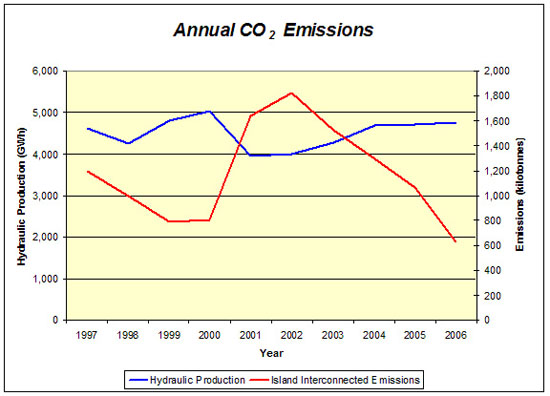
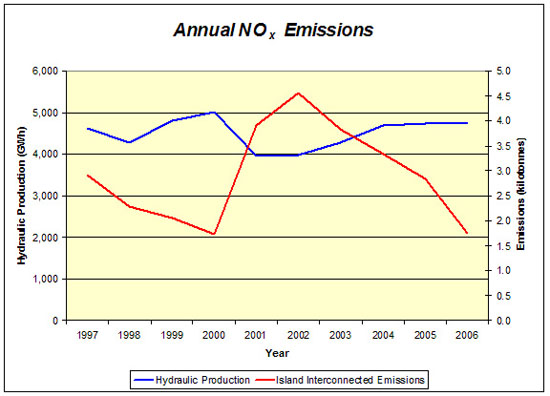
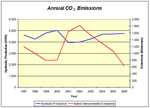
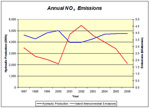
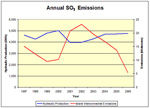
Total emissions were lower in 2006 than 2005 as a result of lower thermal production. Thermal production at the Holyrood Thermal Generation Station in 2006 reached one of its lowest production levels in approximately 20 years at 12% of the island’s energy requirements. This was in part due to an abundance of water to supply the hydro reservoirs and the shutdown of a large industrial customer in Stephenville. The thermal production change reduced overall emissions, but increased emissions intensity for both carbon dioxide (CO2) and nitrogen oxides (NOx) due to the impact on the operation of thermal units. Sulphur dioxide (SO2) total emissions and emissions intensity were significantly lower due to reduced loading level and a switch to 1% sulphur fuel in March of 2006.
Total emissions for CO2, NOx and SO2 for the Holyrood Thermal Generating Station, gas turbines and isolated diesel generating stations are calculated using formula approved by the Department of Environment and Conservation. Emissions of CO2, NOx and SO2 for the isolated systems were 38,498 tonnes, 1,191 tonnes and 47 tonnes respectively. Emissions for the Island Interconnected System, which include the Holyrood Thermal Generating Station, and interconnected gas turbines and standby diesel plants are outlined in the following graphs. Note that the emissions for the Island Interconnected System are provided in kilotonnes, whereas those for the isolated systems, noted above, are in tonnes. This reflects the dominant affect of the Holyrood Thermal Generating Station on overall volumetric emissions from Hydro’s facilities.
Back to Top
 |
|
 |
|
 |
| Click to Enlarge |
|
Click to Enlarge |
|
Click to Enlarge |
Back to Top
Calculations of annual Suspended Particulate emissions from the Holyrood Thermal Generating Station are based on the unit emission rates derived from the most current stack emission testing, and are estimated using formula approved by the Department of Environment and Conservation. The latest stack emission testing was conducted in April 2005. Testing was completed under high load (target between the 85th and 95th percentile of the daily rates from the past three years). Average operating loads for Unit 1, Unit 2, and Unit 3 in 2006 were 76.9 MW, 64.7 MW and 69.1 MW respectively. The average operating load experienced in 2006 was considerably lower then the 2005 test load, therefore the particulate emission rates were prorated based on the average operating load.
Suspended Particulate emissions from Hydro’s diesel generation stations, and gas turbine generation facilities, are based on unit emission rates and unit operating hours. Suspended Particulate emissions were also calculated using approved formula.
In estimating Suspended Particulate emissions from gas turbines and diesel generators it is assumed that each unit operates at 100% load (full load) for every hour of operation. This is an extremely conservative estimate; as such an operating condition does not typically occur. The operating load of each gas turbine and diesel generator is dependent upon the load demand and the number of units operating at any given time.
The total Suspended Particulate emissions for Holyrood Thermal Generating Station, diesel generators, and gas turbines was 607 tonnes. Approximately 93% or 564 tonnes came from Holyrood Thermal Generating Station and the remaining 7% or 43 tonnes were emitted from the diesel generators and gas turbine facilities.
On March 21, 2006, Hydro started burning cleaner fuel at its Holyrood Thermal Generating Station. The switch from 2% to 1% sulphur fuel will significantly improve emissions from the plant. The cleaner fuel will decrease SO2 emission rates by 50% and reduce particulate emission rates by 40%. In 2007, stack sampling and air dispersion modelling will be performed at the plant to confirm the predicted reductions in SO2 and particulate emissions.
Back to Top
Other Emission Reduction Initiatives
Idling produces pollution through emissions of CO2, however, doing something as simple as turning off the vehicle’s engine can have an enormous impact on the environment.
In support of this, Hydro’s corporate office in St. John’s (Hydro Place) has become an idle-free building. Anti-idling signs have been placed in various locations around the outside of the building to remind the general public, employees, suppliers and contractors to turn off their vehicle engines. Employees have also been asked to refrain from idling their vehicles in the parking lot.
In 2007, Hydro is planning on expanding the idle-free program to other facility buildings throughout the province.
Holyrood Thermal Generating Station Human Health Risk Assessment
In 2004, Cantox Environmental Incorporated (CEI), a company with over 20 year’s experience in the field of toxicology risk assessment, in association with A.J. Chandler & Associates Limited was contracted by Hydro to update a Human Health Risk Assessment (HHRA) conducted in 1999 on air emissions from the Holyrood Thermal Generating Station. To conduct this updated study, additional information that was collected subsequent to the 1999 assessment, and other data which Hydro collected in response to the conclusions and recommendations made by CEI in the 1999 HHRA, were assessed.
The updated 2004 HHRA concluded that there are no long-term health effects from emissions from the plant, and that the likelihood of adverse health effects is considered to be low. Low likelihood means that the air quality conditions associated with the plant are not expected to lead to chronic health effects. Short-term exceedances over health-based guidelines for criteria air contaminants may have occurred and could occur into the future. However, these exceedances have occurred infrequently in the past, and based on the available data are short-lived and would not be expected to result in any long-term health effects or permanent damage. Future increases in production would not be expected to result in chronic health effects, but the frequency of exceedances over short-term health-based guidelines could increase.
The 1999 HHRA and the updated 2004 HHRA were conducted to determine if air emissions from the Holyrood Thermal Generating Station have adverse health effects on people living in nearby communities. Although not a regulatory requirement, Hydro involved provincial government Departments of Health and Environment and Conservation in the planning and implementation of these studies. Upon request of the community, the 2004 assessment was peer reviewed by Health Canada, who concluded that the assessment used appropriate and standard approaches that are based on sound science. The Department of Environment and Conservation coordinated the peer review by Health Canada, independent of Hydro. The assessment was also reviewed by the Departments of Environment and Conservation and, Health and Community Services.
In June 2006, Hydro communicated directly with stakeholders on the results, conclusions and recommendations of the updated HHRA. Hydro informed the public upon the release of the report and posted the report and corresponding documents on its website. In addition, Hydro held small group information sessions with area residents, municipal leaders, local physicians and government officials to discuss the findings and recommendations of the HHRA and to listen to their concerns and address their questions. Hydro invited CEI to attend some of these sessions to provide a technical briefing to participants.
|
|
|