|
|
 |
| |
PCBs
Polychlorinated Biphenyls (PCB) is the most significant waste management issue in the electric utility industry. This substance was commonly used in electrical equipment prior to the late 1970s, when PCB production was banned. The effect of this ban on Hydro and many other utilities was two-fold. The amount of PCB in service declined as new PCB-free equipment was installed and inventories of PCB-contaminated wastes increased as older equipment was retired.
Hydro has had a PCB management program in place since the early eighties to reduce risks associated with in-service equipment containing PCB. The earlier focus of this program was to remove all high concentration PCB equipment from service. This was successfully accomplished by 2003.
In 2002, Hydro developed an EMS program focused on PCB reduction. From 2002 to current, the focus has been to identify and remove all distribution transformers with PCB levels greater than 50 parts per million (ppm). To achieve this, a survey of all distribution systems was completed to identify distribution transformers that remain in service and have an unknown concentration of PCB. The survey identified around 3,500 distribution transformers requiring testing. To date, approximately 3,000 transformers have been tested. In 2007, about 719 transformers were tested, with 14 having PCB concentrations greater than 50 ppm. Hydro plans to have all distribution transformers tested, and any showing PCB levels greater than 50 ppm, removed from service by the second quarter of 2010.
In 2007, one tonne of low-level PCB material was placed in storage at Hydro’s Bishop’s Falls PCB waste storage facility. Four tonnes of low-level PCB material was removed from storage and sent for destruction during 2007. At the end of 2007, there was one tonne of low-level PCB material and no high-level PCB material in storage.
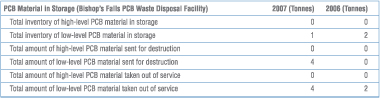

Table 1: PCB material in storage and in service in Bishop’s Falls and TRO Operations in 2007 and 2006.
It is recognized that some older equipment such as capacitors and fluorescent light ballasts, which may contain high levels of PCB, remains in service. It is estimated that there is less than one tonne of PCB contained in this equipment.
Table 2 provides an inventory of PCB material in storage and in service at Churchill Falls facilities at the end of 2007. At present, the total amount of low and high-level PCB material in storage in the Churchill Falls PCB waste storage facility is less than one tonne. There was less than one tonne of high and low PCB material sent for destruction in 2007. PCB material known to be in service are ballasts and capacitors; however, there is no inventory completed of this electrical equipment to date.
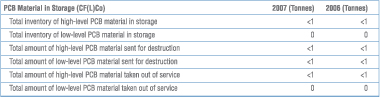

Table 2: PCB material in storage and in service in CF(L)Co in 2007 and 2006.
REUSE AND RECYCLING INITIATIVES
Lubricating Oil
Hydro currently has a waste oil management system for handling and disposing of various types of used oil. On an annual basis, the company records the amount of used base oil generated and new oil purchased at diesel generating stations and hydroelectric generating system. In 2007, approximately 45,260 litres and 4,060 litres of used base oil were collected from these systems, respectively, for either recycling or reuse.
At Hydro’s central maintenance facility in Bishop's Falls, approximately 76,850 litres of insulating oil was reused. Approximately 26,400 litres of this insulating oil was reused following processing or cleaning by internal forces, while 50,450 litres was reused following processing or cleaning by a third-party contractor. Approximately 1,025 litres was disposed of as waste. This represents a 98 per cent reuse of insulating oil at the central maintenance facility.
At CF(L)Co, approximately 42,860 litres of waste oil; 1,860 litres of glycol; 450 litres of low flash point liquids; 13,120 litres of oily sludge; 7,800 litres of waste fuel; 100 litres of aerosols; 40 litres of epoxy; 1,230 litres of grease; and 40 litres of trichloroethylene were collected, and stored at the waste oil storage building. This was later disposed of by a third-party contractor for reuse or recycling.
In addition, approximately 200,000 litres of insulating oil was collected from transformer T1 and T11, as part of CF(L)Co’s Luminol replacement program, and disposed of by a third -party contractor for reuse or recycling.
Due to the remoteness of Churchill Falls, all waste oil is stored at the waste oil storage building prior to disposal. The waste oil is usually collected twice during the year and involves a certified waste handler travelling hundreds of kilometres through the interior of Labrador.
Wood Pole Line Management Program
As part of its transmission line network, Hydro manages approximately 26,000 poles of varying age. Wooden poles have an economic lifespan of about 40 years and an in-service lifespan of 50 years. With proper management, maintenance and refurbishment the life can be extended by 10 years or more. Core samples taken from some poles in 1998 indicated that the preservative retention level was not adequate. As a result, Hydro initiated a wood pole line management program in 2003 and it is expected to continue as a long-term asset management and life extension program. In 2007, Hydro treated 2,416 poles with boron rods to provide extra protection and extend the in-service life expectancy of new poles
Disposal of Fuel Ash at Holyrood Generating Station
During 2007, all fuel ash produced at the Holyrood Generating Station was disposed of in an on-site, controlled solid waste landfill. The amount of total ash produced and disposed of at the landfill in 2007 was 373 tonnes.
Scrap Metal Recycling and Reuse
During 2007, Hydro decommissioned 166 distribution transformers, all of which were sold to a transformer manufacturer for reuse. In addition, approximately 2.5 tonnes of scrap metal and miscellaneous scrap (which included: communications cable, radiators, stainless steel and aluminum) were auctioned and recycled.
Waste Audit and Landfill Diversion Options for CF(L)Co
Reducing household and business waste is an important step to preserving the environment for future generations. Living in a remote community like Churchill Falls poses particular challenges and places more importance on reducing waste to preserve the environment. In the fall of 2007, CF(L)Co engaged a consultant to identify and quantify solid waste streams in residential, commercial and industrial operations, and to develop options for waste diversion to facilitate planning of activities aimed at diverting solid waste from the landfills. It was estimated that approximately 600 tonnes of garbage enters the two landfills at Churchill Falls annually, with about 28 per cent classified as organics, 27 per cent construction material, 19 per cent fibre and 12 per cent plastic. Based on the results, it was decided to implement landfill diversion methods in a staged approach beginning with the diversion of organics via composting in 2009, followed by implementation of a recycling depot for recyclables and fibre in 2010 and 2011 and waste reduction initiatives in 2012.
Construction Debris Removal Plan for CF(L)Co
In 2006, CF(L)Co management received approval from the Board of Directors for funding for a five-year program to clean up the debris from abandoned construction camps that were used as part of the original construction of the Churchill Falls project in the late 1960s and early 1970s. Over a five-year period, CF(L)Co has committed to clean up five large sites with the aid of contractors, and five smaller sites with CF(L)Co personnel.
2007 marked the first year of this clean up program during which five dumps were cleaned up in the Twin Falls area, plus five smaller sites in the town of Churchill Falls, the plant and airport areas. Approximately 400 tonnes of metals were removed from the Twin Falls dump sites.
Asbestos Management - Holyrood Generating Station
In 2007, Hydro completed the final year of a three-year program to remove all friable asbestos from the Holyrood Generating Station. The balance of plant and common systems had all friable asbestos insulation removed and replaced with non-asbestos insulation.
|
 |
 |
Copyright © 2008 NL Hydro, All rights reserved. |
 |
|
|
 |
|