|
|
 |
| |
LABRADOR WOODLAND CARIBOU
CF(L)Co has existing transmission, generation and control facilities within the range of both the Lac Joseph and Red Wine Mountains caribou herds. The proposed lower Churchill Project also falls within the range of these sedentary woodland caribou herds. The Committee on the Status of Endangered Wildlife in Canada (COSEWIC) designated these herds as "threatened" under the federal Species at Risk Act (SARA) in 2001, and the Minister of Environment and Conservation also designated these herds as "threatened" under the provincial Species at Risk Act in July, 2002. Hydro currently has an employee representative on the Labrador Woodland Caribou Recovery Team.
In 2007, participation with the Labrador Woodland Caribou Recovery Team continued as the team focused on defining critical habitat for inclusion in the Recovery Action Plan which is scheduled for completion by the end of 2008.
FISHERIES CCOMPENSATION WATER RELEASE
In 2007, as part of long-term agreement with the Department of Fisheries and Oceans, Hydro released approximately 132.5 MCM of water at its fisheries compensation facilities. Water releases were preformed at White Bear River, Grey River, Granite Canal, Upper Salmon and Hind's Lake at critical times throughout the year for habitat protection and fish migration. Because of the isolated nature of the island’s electrical system, lost hydroelectric energy production associated with these water releases must be provided by thermal generation from the Holyrood Generating Station. The amount of thermal production required to offset the amount of water released in 2007 was 35.7 gigawatt hours (GWh). When the thermal conversion rate and average cost of fuel are considered, the equivalent value of the water released at all fisheries compensation facilities was approximately $3.1 million and resulted in 177 tonnes of sulphur dioxide emissions and 29,000 tonnes of carbon dioxide emissions.
COOK'S HARBOUR OSPREY NEST RELOCATION
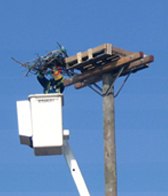 Hydro’s ground and line crews from the St. Anthony line depot relocated an Osprey Nest in the community of Cooks Harbour on the Northern Peninsula. In 2006, TRO Northern Region reported that a pair of Osprey built a nest on a structure which threatened the power supply to the communities of Cooks Harbour, Boat Harbour and Wild Bight. The concern was that because this structure has a gang switch, nest material could possibly cause a short in the line. In June 2007, crews were involved in the installation of a new pole and platform next to the existing structure. With the nest removed and placed on the newly installed platform, copper grounding wire was placed on the existing structure to mitigate against the birds returning. After the work was completed on the site, the nest was monitored for a period of time. Initially the adults tried unsuccessfully to land back on top of the old structure where the nest had been located, but within a couple of days utilized the newly installed platform.
GRANITE CANAL FISH HABITAT COMPENSATION FACILITY
Between 2001 and 2003, Hydro constructed the Granite Canal Hydroelectric Generating Station. Located within the Bay d’Espoir Hydroelectric Generating System, the plant has a rated capacity of 40MW. The diversion of water for power generation virtually eliminated flow between the previous outflow of Granite Canal and Meelpaeg. This resulted in fish habitat losses of up to 436 units of salmonid spawning and rearing habitat that was utilized by ouananiche and, to a lesser extent, brook trout. Based on this, Hydro was required to construct a Fish Habitat Compensation Facility (FHCF) and enter into an agreement for the monitoring of the facility until 2010. In 2007, the fourth compensation monitoring report was completed. Results indicate spawning densities were positive with over 1,640 potential redds (highest recorded to date) observed in the FHCF. Standing stocks for all habitats surveyed in the FHCF were typical, and in some cases, higher than those found in natural systems. It was also noted that more juvenile brook trout and ouananiche were recorded than in previous years.
SPECIES AT RISK
Since 2000, Hydro has been conducting floral assessments on a number of distribution lines across the sensitive limestone barrens habitat of the Northern Peninsula. These assessments are usually part of a capital construction project or upgrade on a specific distribution line and have been conducted by a botanist and local rare plant experts on lines in the areas of Trout River, Point Riche, Barbace Point, Cooks Harbour, Boat Harbour and Cape Norman.
Many plant species listed under the Species at Risk Act (SARA) and the Newfoundland and Labrador Endangered Species Act that have been found near Hydro’s distribution lines, so Hydro has established a detailed list of where these plants are located on Hydro structures and assess trails. Over the next few years, Hydro will identify all areas of concern on the Northern Peninsula and use this data to ensure that employees responsible for maintenance and upgrades of these lines are aware of the presence of such species and can take appropriate precautions to avoid damage to the plants or habitat. The scope of work in 2007 involved assessing all structures on the distribution lines, access routes, and private property from Bear Cove to Eddies Cove for the presence of rare plant species.
|
 |
 |
Copyright © 2008 NL Hydro, All rights reserved. |
 |
|
|
 |
|