|
|
 |
| |
Hydro has chosen the ISO 14001 Environmental Management System (EMS) standard developed by the International Organization for Standardization to drive the continual improvement of the company’s environmental performance.
Through the EMS, Hydro seeks to mitigate its impact on the environment. Programs developed under EMS cover a broad range of areas: alternative energy and conservation, emissions control, waste management and recycling, spills management, environmental site assessment and remediation, and species and habitat diversity. Hydro’s EMS and ISO 14001 certification are key components of this commitment and they will continue to be the cornerstone of the company’s environmental work.
Hydro’s EMSs provide the company with a solid framework for environmental management and continual improvement. Hydro is committed to managing its operations to reduce its environmental impact, while balancing its mandate to provide customers with safe, reliable, least-cost power. All Hydro divisions have been ISO 14001 certified since 2004, and this gives added assurance to all stakeholders of continued environmental excellence.
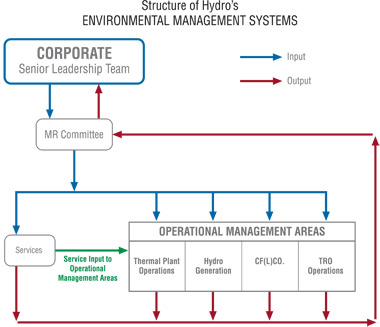
The six designated MA (Figure 1) within Hydro manage their environmental aspects through EMSs. Each EMS is certified and registered by a third party, Quality Management Institute (QMI) (www.qmi.com).
While the company made progress in reducing its impact on the environment in 2007, Hydro will continue to develop long-term plans to achieve its environmental targets and goal of becoming an environmental leader. Throughout the year, Hydro improved its electronic EMS documentation, reduced the number of EMS surveillance audit issues and increased the frequency of reporting on EMS performance to the leadership team. Additional accomplishments resulting from the EMP in each of the MA in 2007 are detailed in this section.
CORPORATE MANAGEMENT AREA
The Corporate Management Area consists of the leadership team and a committee of managers with responsibilities for facilities and operations with environmental aspects. The goal of this MA is to co-ordinate the development and maintenance of the overall EMS for Hydro and to identify environmental aspects appropriate to the leadership team’s activities and responsibilities. Although the operational and services EMS are managed independently, a common and consistent Corporate Environmental Policy and Guiding Principles sets the standard. Periodic reviews of activities and issues are conducted to ensure consistency with corporate standards.
Two years ago, Hydro developed a corporate strategy for the company that sets the stage for performance and will guide the company’s direction. This strategy involved developing goals, objectives and targets for the company. The following objectives have been established for Hydro’s environmental goal, to be an Environmental Leader:
- Displace 300,000 barrels of oil by 2009 by increasing the use of renewable energy sources and through Conservation Demand Management (CDM) initiatives.
- Displace an additional 150,000 barrels of oil by 2012 by increasing the use of renewable energy sources and through CDM initiatives.
- Decrease emissions at the Holyrood Generating Station and the isolated diesel plants.
- Increase awareness of conservation and energy efficiency opportunities among electricity users.
- Develop a CDM potential study.
- Decrease the risk of leaks and spills to the environment.
- Reduce energy usage by the Hydro Group.
- Increase the number of leadership team approved EMS targets and objectives accomplished.
Out of these objectives, Hydro has set targets for: increasing the number of leadership team approved EMS targets and objectives accomplished within Hydro, Labrador and island wind projects and sulphur dioxide (SO2) emission reductions at the Holyrood Generating Station.
In support of decreasing SO2 emissions, Hydro started burning cleaner fuel at the Holyrood Generating Station; switching from two per cent sulphur to one per cent sulphur. Stack emission testing conducted in 2007 indicated a significant reduction in sulphur and total suspended particulate at the Holyrood plant since the switch to one per cent sulphur fuel in March 2005. The 2007 stack sampling results indicates a reduction of approximately 50 per cent for sulphur and 45 per cent for total suspended particulate, when compared to 2005.
SERVICES MANAGEMENT AREA
Currently there are four groups within the Services Management Area that have environmental aspects identified. These groups include Systems Operations and Customer Services, Engineering, Supply Chain Management and Environmental Services.
In 2007, results included:
- A ground breaking for the province’s first commercial wind farm – a 27 MW project in St. Lawrence on the Burin Peninsula.
- Continuing monitoring activities in Labrador to determine the wind resource potential in conjunction with the Lower Churchill Project.
- Securing three million dollars from the Atlantic Innovation Fund towards a five-year, $10 million innovative research and development project for Ramea’s isolated wind-hydrogen-diesel generation solution.
- Celebrating the first annual HYDROWISE Energy Efficiency Week.
- Completing the fourth compensation monitoring report for the Granite Canal Fish Habitat Compensation Facility. Results indicate spawning densities were positive and over 1,640 potential redds (highest recorded to date) were observed in the compensation facility.
- Releasing over 130 million cubic metres (MCM) of water from fisheries compensation facilities, as part of long-term agreements with the Department of Fisheries and Oceans for fish and fish habitat protection.
- Ongoing progress on a program to improve load efficiencies at the Holyrood Generating Station and Hydro Generation.
- Distributing almost 15,000 compact fluorescent bulbs (CFLs) to over 3,700 homes in Labrador West, as part of the SAVE (Shared Atlantic Vision for Energy Efficiency) community initiatives program.
- Delivering a half-day energy efficiency workshop to 25 fire brigade volunteers from Glenburnie-Birchy Head-Shoal Brook to prepare them for their fire safety and energy conservation walkthroughs of the 200 homes in their community.
- Assessing all structures on the distribution lines, access routes, and private property from Bear Cove to Eddies Cove for the presence of rare plant species.
- Completing a joint test of the Environmental Emergency Response Plan with Materials Control and Operations staff in Bay d'Espoir and Bishop's Falls.
OPERATIONAL MANAGEMENT AREAS
Thermal
The Holyrood Generating Station is a 490 MW plant located in Holyrood. The Holyrood plant’s EMS was initially registered in January 1999 and successfully completed a surveillance audit in 2007.
In 2007, the Holyrood Generating Station made progress on 13 Environmental Management Programs (EMP), resulting in:
- Improved efficiency of the conversion of fuel energy and associated reduction in selected emissions intensities.
- Development and submission of noise emissions and waste management plans.
- Completion of a stack sampling program and initiation of air emission dispersion modelling.
- Collection and analysis of soil samples at over 50 sites to support data that was used in a human health risk assessment of air emissions at the Holyrood plant.
- Replacement of a 30-year old section of fuel transfer piping under the Holyrood plant roadway.
- Completion of the final year of a three-year program to remove all friable asbestos from the plant. The total cost of the 2007 program was approximately $3.6 million.
- Continuation of the removal of PCB waste and recycling of scrap metal.
Hydro Operations
The Bay d’Espoir Management Area consists of eight generating stations on the island with an installed capacity of 939 MW.
In 2007, some of the EMP results included:
- A study to evaluate the risk associated with the storage and handling of 205 litre drums at various facilities within Hydro Generation.
- The commissioning of a new bulk fuel monitoring system at the Cat Arm Hydroelectric Generating Station.
- A risk assessment of assets having the highest leak potential.
- The installation a sump pump control system at the Hind’s Lake Hydroelectric Generating Station and the performance of maintenance activities on generator units at other locations to reduce leaks.
- Promotion of an anti-idling program.
- The commissioning of a remote system for the operation of a fisheries compensation water releases at the Granite Canal Generating Station to ensure adequate year-round flow.
- The development of an environmental awareness program and conducting additional environmental awareness training sessions for Hydro Generation personnel.
Churchill Falls (Labrador) Corporation (CF(L)Co)
The Churchill Falls Hydroelectric Generating Station has an installed capacity of 5,428 MW. Associated with this development is approximately 1,200 km of high-voltage transmission lines, an airport and the Town of Churchill Falls. Environmental aspects of these facilities are included in the EMS. The environmental aspects of the decommissioned Twin Falls Hydroelectric Generating Station are also managed through CF(L)Co’s EMS. The EMS was registered in 2000 and successfully completed a surveillance audit in 2007.
Some of the results of CF(L)Co’s 2007 EMS were:
- The continued use of environmentally-friendly wicket gate grease and transformer oil, with 10 of 11 turbines and 10 of 11 transformers converted to environmentally-friendly products to date.
- A monitoring program to ensure ability to prioritize maintenance for turbine units that experienced the highest oil losses. One turbine unit is repaired per year.
- Completion of five Phase I Environmental Site Assessments, four Phase II Environmental Site Assessments and Environmental Risk Assessments and three site remediations.
- Replacing deteriorated oil gaskets on four switchyard transformers.
- Presenting the research results from a greenhouse gas (GHG) study that was completed in 2006 at the annual conference of the Canadian Dam Association.
- Completing year one of a five-year clean up program which included the clean-up of five dumps in both the Twin Falls and Churchill Falls areas.
- Designing a central composting facility for construction in 2009.
- The installation of a remote leak detection system at one control structure and approximately 40 metres of fuel transfer piping was repaired or replaced.
Transmission and Rural Operations
The Transmission and Rural Operations (TRO) Division assets include three gas turbines, three interconnected diesel generating stations, and 21 isolated diesel generating and distribution systems. Hydro also maintains 54 high-voltage terminal stations, 25 lower-voltage interconnected distribution substations, 3,742 km of interconnected high-voltage transmission lines and 3,360 km of distribution lines.
In 2007, significant accomplishments in TRO included:
- Continuing with the implementation of a five-year plan for improvements to prevent potential environmental impacts from fuel storage systems.
- Developing a detailed test plan for electrical equipment potentially containing PCBs and implementation of a records management process.
- The continuation of a study for alternate forms of herbicide applications to reduce the use of herbicides for vegetation control.
- Continuing the environmental assessments of properties that may have sensitivities to herbicide application.
- Decommissioning 166 distribution transformers, all of which were sold to a transformer manufacturer for reuse. In addition, approximately 2.5 tonnes of scrap metal and miscellaneous scrap were auctioned and recycled.
- Initiating a review of historic efficiency performance and energy usage at diesel plants and identification of areas for improvement.
- Continuing to collect information related to environmental sensitivities for transmission and distribution lines in TRO Central, Northern and Labrador.
- Ongoing success with the wooden pole reuse program with respect to tracking treated-wood material removed from service, recycled, reused, stored or disposed.
|
 |
 |
Copyright © 2008 NL Hydro, All rights reserved. |
 |
|
|
 |
|