|
|
 |
| |
WASTEWATER CONTROL
The Holyrood Generating Station’s wastewater treatment plant treats the wastewater resulting from the combustion of fuel and run-off from an on-site solid waste landfill. Components of the wastewater are measured and compared to regulatory limits. Once all aspects of the wastewater meets provincial regulatory requirements, it is released into the environment. In 2007, 4.83 million litres of wastewater was treated and discharged, a significant decrease from the 5.56 million litres of wastewater processed in 2006. This was primarily due to the switch to one per cent sulphur fuel at the Holyrood plant in 2005 which in turn reduced the necessity for air preheater washes. When the Holyrood Generating Station was burning two per cent sulphur fuel approximately 20 air preheater washes were needed to be performed annually compared with only two washes in 2007; thus significantly reducing the amount of wastewater that required treatment.
AIR QUALITY MANAGEMENT
Hydro has a mandate to meet the province’s growing electricity needs. Most of this electricity comes from clean hydroelectric power; however, between 15 and 25 per cent of the island’s electricity comes from fossil-fuel fired generation from the Holyrood Generating Station each year. The amount of thermal generation depends on demand and the amount of water available in reservoirs for hydroelectric generation. When water levels increase in the reservoirs, the demand on thermal generation decreases, as does associated air emissions. The company has a clear focus on minimizing thermal generation as much as possible, while still meeting customer demand.
As a result of higher thermal production, total emissions were higher in 2007 than 2006. Thermal production at the Holyrood Generating Station increased in 2007 primarily due to higher energy consumption on the Island Interconnected System driven by a return to normal weather conditions which in turn caused higher space heating requirements. Thermal generation also increased because of lower than normal inflows to the hydroelectric system reservoirs during the spring and summer of 2007. Reservoir storage levels recovered in the fall and fossil generation was reduced to minimum levels. It should be noted that in 2006 thermal production at the Holyrood Generating Station reached one of its lowest production levels in approximately 20 years at only 12 per cent of the island’s energy requirements. This was in part due to an abundance of water to supply the hydro reservoirs and the shutdown of a large industrial customer in Stephenville.
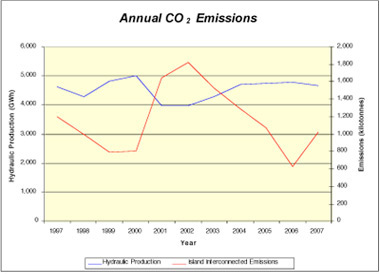
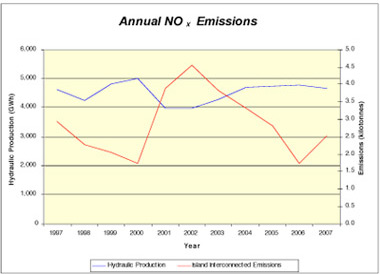
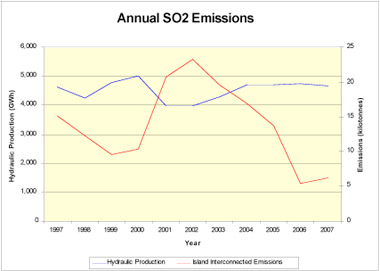
Total emissions for carbon dioxide (CO2), nitrogen oxides (NOx) and SO2 for the Holyrood Generating Station, gas turbine facilities and isolated diesel generating stations are calculated using formula approved by the Department of Environment and Conservation (DOEC). Emissions of CO2, NOx and SO2 for the isolated systems, which includes the Labrador Isolated Diesel and Interconnected Systems and the Island Isolated Diesel System, were calculated to be 39 kilotonnes, 1.2 kilotonnes, and 0.05 kilotonnes respectively. Emissions for the Island Interconnected System, including the Holyrood Generating Station, and interconnected gas turbines and the standby diesel plants are outlined in the following graphs:
PARTICULATE EMISSIONS
Calculations of annual Suspended Particulate emissions from the Holyrood Generating Station are based on the unit emission rates derived from stack emission testing, and are estimated using formula approved by the DOEC. The latest stack emission testing was conducted in March 2007 and was completed under high load (target between the 85th and 95th percentile of the daily rates from past three years). Testing of Unit 1 at the Holyrood plant was not possible in 2007 due to a breakdown of a forced draft fan immediately prior to testing. Due to the similar configuration and operating characteristics of Unit 1 and Unit 2, the same emission rates were assumed for each unit.
The average operating loads for Unit 1, Unit 2 and Unit 3 in 2007 were 69.51 MW, 110.12 MW and 89.39 MW respectively. The average operating loads experienced in 2007 were considerably lower than the 2007 test load, therefore emission rates were prorated based on the average operating load.
The 2007 stack sampling results indicates a reduction of approximately 50 per cent for sulphur and 45 per cent for total suspended particulate, compared to 2005.
In 2007, the total combined Suspended Particulate emissions for the Holyrood Generating Station, diesel generators and gas turbines was 596 tonnes. Approximately 92 per cent or 551 tonnes came from the Holyrood plant and the remaining eight per cent or 45 tonnes was emitted from the diesel generators and gas turbine facilities.
OTHER EMISSION REDUCTION INITIATIVES
Idling produces pollution through emissions of CO2, however, doing something as simple as turning off the vehicle’s engine can have an enormous impact on the environment.
In support of this, in 2006 Hydro’s Head Office in St. John’s became an idle-free building. In 2007, Hydro expanded this initiative to five other company buildings.
HUMAN HEALTH RISK ASSESMENT UPDATE
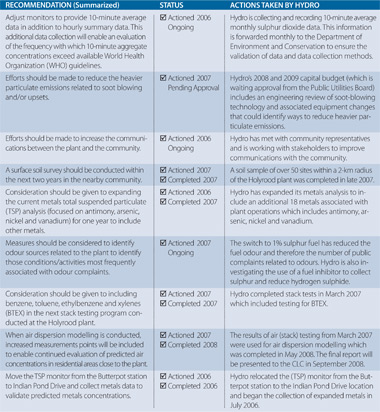
In June 2006, Hydro released the results of a human health risk assessment on air emissions from the Holyrood Generating Station. Hydro contracted Cantox Environmental Inc. (now Intrinsic Environmental) to conduct this assessment. In its report, Intrinsic made nine recommendations to Hydro in relation to the operation of the Holyrood plant.
Since the release of the report, Hydro has taken action on all nine recommendations. Here is a brief summary of the recommendations made to Hydro and actions taken to date:
SOIL SAMPLING CONDUCTED IN HOLYROOD
One of the recommendations outlined by Intrinsic Environmental was to conduct a surface soil survey on sites around the plant to provide greater certainty to the data used in the assessment. In August 2007, Hydro contracted Jacques Whitford Limited to conduct a surface soil sampling program on over 50 sites in the vicinity of the Holyrood plant. The survey also included soil sampling in reference sites in Witless Bay and Branch. Intrinsic Environmental then compared the Holyrood samples to the reference sites and soil quality guidelines. The samples were also analyzed for a broad suite of chemicals.
The comparison of the Holyrood soil data to the reference sites and soil quality guidelines indicates that adverse human health effects would not be expected from either direct contact (soil ingestion, skin contact) or from water exposure pathways as a result of the area surface soil chemical concentrations.
|
 |
 |
Copyright © 2008 NL Hydro, All rights reserved. |
 |
|
|
 |
|