|
|
 |
| |
Wind is a valuable energy resource and Hydro has developed a strategy to leverage this source of clean, renewable energy. Hydro’s wind development strategy involves pursuing three distinct opportunities. The company operates three separate electricity systems in the province: the Island Interconnected System, the Labrador Interconnected System and the Isolated Diesel Systems (comprised of 21 diesel generation sites located in remote coastal communities around the province). Hydro is investigating opportunities that exist to incorporate wind power into each of these separate systems.
ISLAND INTERCONNECTED SYSTEM
The island electrical system is isolated from the North American grid and has an existing generating capacity of 1,919 MW provided by approximately 65 per cent hydroelectric and 35 per cent fossil fuel generation.
In 2007, Hydro secured power purchase agreements for 54 MW of wind power on the island – 27 MW wind projects in both St. Lawrence on the Burin Peninsula, and Fermeuse on the Southern Shore of the Avalon Peninsula. Both projects are expected to be in production by the end of 2008.
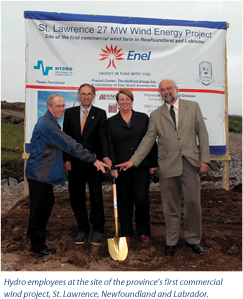
On July 26, 2007, the sod turning took place for the province’s first commercial wind farm in St. Lawrence. Construction of the three, nine MW wind turbines will begin in the summer of 2008 and is expected to generate approximately 100,000 megawatt hours of power per year.
When compared to the cost of burning oil at the Holyrood Generating Station, the wind projects in St. Lawrence and Fermeuse will save consumers approximately seven million dollars each year over the 20-year life of the contract.
Annually, the environmental benefits from the wind projects are:
- Displacing 300,000 barrels of oil annually at the Holyrood plant.
- Reducing sulphur dioxide emissions by over 900 tonnes.
- Reducing carbon dioxide emissions by over 140,000 tonnes.
- Generating green energy for the equivalent of 14,000 homes.
ISOLATED DIESEL SYSTEMS
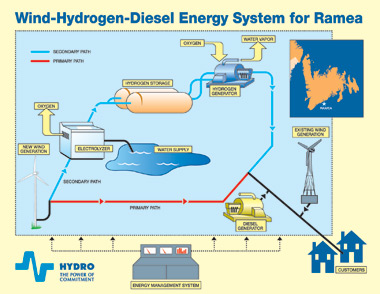
Hydro relies on diesel-fuelled generation systems to provide power to more than 20 small, coastal communities across the province. The remote island community of Ramea, on the South Coast of Newfoundland, has been the location of a pilot project with wind and diesel generation since 2004. In 2004, Hydro began purchasing wind energy from Frontier Power Systems, a non-utility generator. Since then, Hydro has purchased 1,200,000 kilowatt hours (kWh) of wind energy, approximately 10 per cent of Ramea’s energy requirements, and has offset over 325,000 litres of fuel and 500 tonnes of air emissions.
In early 2007, Hydro secured three million dollars from the Atlantic Innovation Fund towards a five-year, $10 million innovative research and development project for an isolated wind-hydrogen-diesel generation solution. This unique energy project has the potential to significantly reduce Hydro’s reliance on diesel generation and provide clean, renewable energy to isolated customers. This project is one of the first in the world to integrate generation from wind, hydrogen and diesel in a remote, isolated electricity system.
Introducing hydrogen to the existing wind-diesel generation system in Ramea will allow excess wind power to be stored and used later, potentially reducing diesel generation when demand is low and running solely on a combination of wind and hydrogen. Success of the project will enable Hydro to develop and implement innovative renewable energy systems to serve isolated and remote areas.
LABRADOR INTERCONNECTED SYSTEM
Labrador has a huge wind resource and development potential of thousands of megawatts. In Labrador, monitoring is ongoing to determine the wind resource potential in conjunction with the Lower Churchill Project. The development of this resource presents different opportunities from that on the island. Since Labrador is connected to the North American electricity grid, the focus of wind energy in Labrador will be for both domestic use and for export. This monitoring program, near the Churchill Falls Generating Station, will provide information for a complete feasibility study for the potential development of the wind resource in Labrador.
|
 |
 |
Copyright © 2008 NL Hydro, All rights reserved. |
 |
|
|
 |
|